

15 Aug 2026 9 min to read
If you are wondering where to see red pandas in Nepal, the Langtang region is one of the most relevant places to consider. Located north of Kathmandu, Langtang National Park protects extensive Himalayan forest and is officially recognized as habitat for the red panda. Nepal Tourism Board lists the red panda among the wildlife found in the park, while the Department of National Parks and Wildlife Conservation identifies Langtang as one of Nepal’s red-panda population areas.

However, it is important to understand what a red panda trek really means. A wild red panda sighting is never guaranteed. These animals are shy, solitary and difficult to observe in their natural forest habitat. A trek designed around red-panda habitat is therefore better described as a wildlife-focused Himalayan trekking experience, not a trip where visitors are promised a sighting.
For travelers who want to combine trekking, forests, mountain scenery and the possibility of observing this rare animal, Langtang and the surrounding northern-central Himalayan landscape deserve particular attention.
The red panda has a wide but fragmented distribution across Nepal’s Himalayan region. The Government of Nepal’s Red Panda Conservation Action Plan records potential habitat across a large area and explains that red pandas occur mainly in temperate and sub-alpine forest between about 2,000 and 4,800 meters, with distribution closely associated with bamboo forests.
Government wildlife information documents red panda presence in several protected areas, including:
The official conservation material also makes an important point: a large proportion of Nepal’s potential red-panda habitat lies outside protected areas. Therefore, the presence of red pandas is not limited to national parks or famous trekking routes.
Nepal Tourism Board gives a simpler description for visitors, stating that red pandas are rarely seen because of their shy nature and may be found from the Langtang region toward the Kanchenjunga region.
Among Nepal’s trekking destinations, Langtang stands out because the connection between the park, forest habitat and trekking infrastructure is particularly clear.
The official Nepal Tourism Board page for Langtang National Park lists the red panda among the park’s wildlife and identifies trekking as one of its principal activities. The same page highlights Langtang Valley, Gosaikunda, and Helambu as attractions of the region.
The Department of National Parks and Wildlife Conservation also describes red panda, locally known as Habre, as one of the notable animals of Langtang National Park. The park contains coniferous and other forest types that support a variety of Himalayan wildlife.
For trekkers, this means you can combine a normal Himalayan journey with wildlife observation rather than traveling exclusively for a difficult wildlife expedition.
The Langtang Valley Trek is especially suitable for travelers who want a classic mountain experience while spending substantial time in forested landscapes.
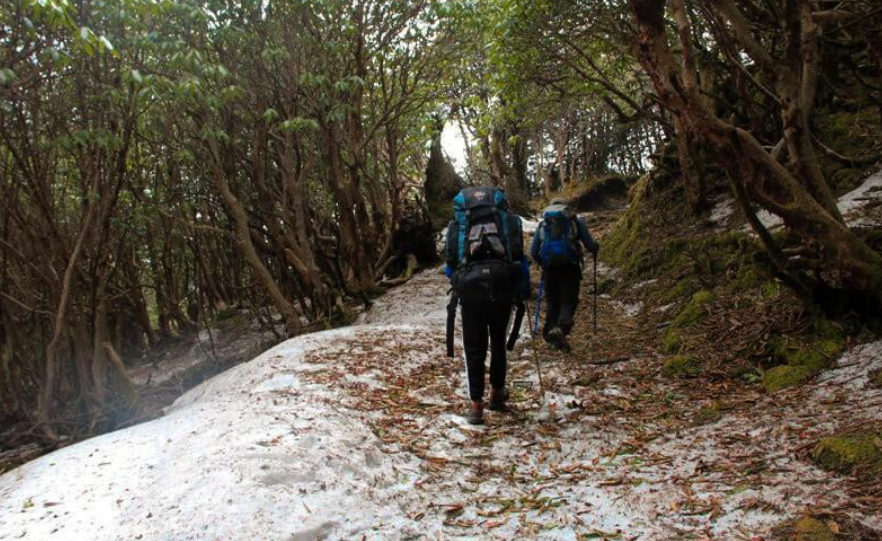
The Langtang Valley is one of the best-known trekking areas inside the Langtang National Park. The journey takes travelers through changing vegetation, traditional settlements, and mountain landscapes before reaching the higher Langtang Valley.
For wildlife enthusiasts, the forest sections are particularly interesting because red pandas depend on suitable forest habitat with bamboo undergrowth. Government wildlife information describes the species as closely associated with montane forests containing dense bamboo thickets.
A trekker should not expect to see a red panda simply because the trail passes through the national park. The animal’s behavior makes sightings difficult. Government information describes red pandas as solitary and notes that they are generally active around the late afternoon and early evening, while spending considerable time resting during the day.
This is why patience matters more than speed when walking through suitable habitat.
Instead of rushing through forest sections, wildlife-minded trekkers can walk quietly, pay attention to movement in the trees and vegetation, and follow the guidance of an experienced local guide.

Helambu deserves to be included in the discussion, but with careful wording.
Nepal Tourism Board identifies Helambu as one of the attractions associated with Langtang National Park. It also lists the Helambu Trek among trekking routes for which the current TIMS provisions apply.
The broader Langtang landscape is recognized as red-panda habitat, but it would be inaccurate to promise that someone trekking through Helambu will see a red panda.
Therefore, a good Helambu itinerary for wildlife enthusiasts should be presented as a trek through a landscape associated with red-panda habitat, rather than as a guaranteed red-panda sighting route.
This distinction is important for responsible tourism. It gives travelers realistic expectations while still allowing them to enjoy the forests, villages and Himalayan scenery.
Red pandas are not animals that normally appear beside busy trekking trails waiting to be photographed.
Official DNPWC information describes them as solitary and territorial, with activity concentrated around crepuscular and nocturnal periods. Their habitat is also closely connected with forest and bamboo.
Their quiet behavior, forest habitat, and limited movement make them difficult to spot.
This is one reason an experienced guide can add value. A guide who knows the local trail and environment can help trekkers move through forest areas appropriately and identify signs of wildlife without disturbing it.
Most importantly, travelers should never chase an animal simply to obtain a photograph.

For trekking in Langtang, the Nepal Tourism Board recommends October-November and March-May as the best seasons. It notes that higher elevations can be cold, while June-September is the monsoon period and December-February can bring snow.
For a red-panda-focused trek, these seasons can provide more comfortable trekking conditions, but there is no official season in which a red panda sighting can be guaranteed.
The best approach is therefore to select a good trekking season for the Langtang region and allow enough time to enjoy the forest environment rather than planning the entire trip around one wildlife encounter.
Langtang should not be presented as the only place where red pandas occur. Government conservation information documents the species across several parts of Nepal.
Makalu-Barun National Park is an important protected area in eastern Nepal. Nepal Tourism Board specifically lists the endangered red panda among its wildlife. The park ranges from subtropical forests toward sub-alpine and alpine environments and is a major destination for wilderness trekking and mountaineering.
However, Makalu-Barun is considerably more remote than Langtang. Nepal Tourism Board describes access via Tumlingtar followed by a long approach trek.
For travelers primarily interested in an accessible red-panda-related trekking experience, Langtang may therefore be more practical.

Kanchenjunga Conservation Area in eastern Nepal is another important area within the red panda’s documented national distribution. Government conservation documents identify Kanchenjunga as one of the country’s red-panda sub-populations.
The area is remote and rugged, with difficult access to many high-elevation locations. The Department of National Parks and Wildlife Conservation describes it as an important biodiversity and conservation landscape.
Government conservation information also records red pandas from Dhorpatan Hunting Reserve and Rara National Park. These areas demonstrate how widely the species’ habitat extends across Nepal.
They should, however, be distinguished from Langtang when discussing trekking convenience and accessibility. The fact that red pandas have been documented in an area does not automatically make it a reliable wildlife-viewing destination.
A responsible red-panda trek should focus on observation rather than pursuit.
When walking through suitable forest habitat:
This is particularly important because red panda habitat faces several conservation pressures. The Government of Nepal’s conservation plan identifies habitat fragmentation, infrastructure development, dogs, climate change and other factors among the threats affecting red panda populations.
Responsible trekking can help ensure that wildlife remains undisturbed while local communities continue to benefit from tourism.

No.
This is perhaps the most important thing to understand before booking a red panda-focused trek.
Langtang National Park is officially recognized as a red panda habitat, but the species is rare and difficult to observe. Nepal Tourism Board itself describes red pandas as rarely seen because of their shy nature.
A reputable trekking company should never promise a guaranteed sighting.
Instead, the goal should be to give travelers the best reasonable opportunity to explore suitable habitat while enjoying the complete Langtang experience.
Even without a red panda sighting, the trek offers forests, Himalayan scenery, Tamang culture, monasteries and the landscapes surrounding Langtang Valley and Gosaikunda.
If your main question is “Where can I see red pandas in Nepal?”, Langtang is one of the strongest places to begin your research.
It has official recognition as a red panda habitat, established trekking routes, and relatively straightforward access compared with Nepal’s more remote eastern and western wildlife areas.
For travelers interested specifically in a red panda trekking experience, Safe Holiday Adventure can design a Langtang or Helambu itinerary around your available days, walking preferences and wildlife interests.
The most important expectation is simple: you are entering the red panda’s natural habitat, not visiting a zoo. A sighting is a privilege, not a promise.
That is what makes the experience special.

Introduction Kathmandu doesn’t ease you in. You step out of the airport into a chorus of horns
Continue Reading
Every Everest Base Camp trekking package includes a line item for “guide” and “por
Continue Reading
Understanding Everest Base Camp Trek Permits Cost is one of the first things every Everest Region tr
Continue Reading
Introduction Namche Bazaar is the beating heart of the Khumbu region and the first major stop for ev
Continue Reading
Standing at the foot of the world’s highest mountain is a moment that stays with you forever.
Continue Reading
The Everest Base Camp trek is moderate to hard. There is no climbing, no ropes and no technical skil
Continue Reading