
4 Mar 2019 13 min to read
Somewhere on Earth, someone is always claiming to have run the “world’s toughest marathon.” Most of those claims don’t hold up. One does. The Tenzing Hillary Everest Marathon starts at 5,364 meters, on the ice and rubble of Everest Base Camp, and finishes 42.195 kilometers later in the market town of Namche Bazaar. No other certified marathon on the planet starts this high. If you’ve ever wondered what it actually takes to stand on that start line, this guide walks you through the whole picture — the history, the route, the training, and how to plan a trip that gets you there in one piece.
The story of this marathon begins with a single date: May 29, 1953, the day Edmund Hillary and Tenzing Norgay Sherpa became the first climbers confirmed to reach the summit of Mount Everest. For fifty years, Nepal celebrated that anniversary quietly. Then, in 2003, a group of organizers decided the milestone deserved something bigger — a race that would test ordinary athletes against the same landscape that had tested the world’s most famous mountaineers.
That first event became the Tenzing Hillary Everest Marathon, and it has run every year since, always timed around May 29 — a date now marked in Nepal as Everest Day. What started as a one-off anniversary event has grown into one of the most recognized endurance races in the world, drawing runners from dozens of countries who come as much for the achievement as for the raw spectacle of running through the Khumbu.
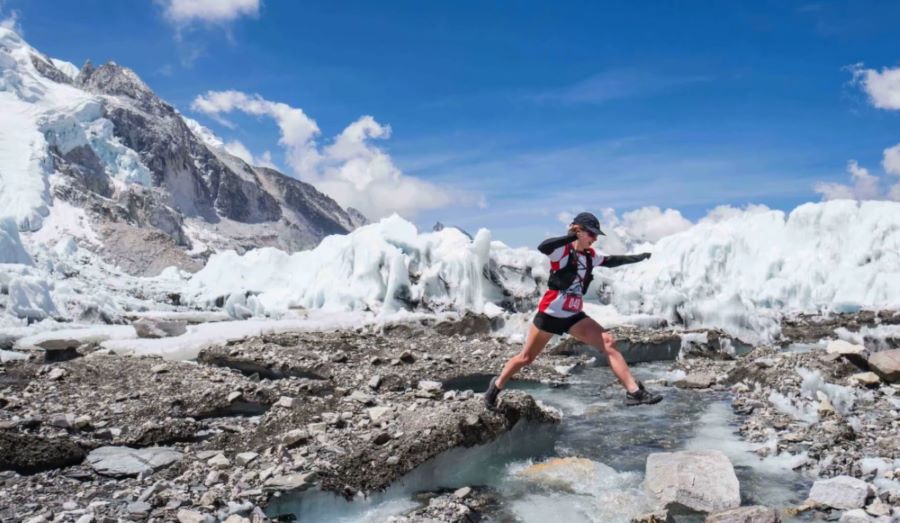
Altitude is what separates this race from every other marathon on the calendar. The start line sits at 5,364 meters (17,600 feet) at Everest Base Camp — higher than the summit of Mont Blanc, higher than the highest road in the Alps, higher than almost anywhere else humans run competitively. From there, the course descends through Gorak Shep, Lobuche, Dingboche, Pheriche, Tengboche, and finally into Namche Bazaar at 3,440 meters.
That’s a net elevation loss of nearly 2,000 meters, but don’t mistake this for an easy downhill cruise. The trail is rocky, narrow, and uneven, crossing suspension bridges and moraine fields where a wrong step matters more than it would at sea level. And the altitude cuts both ways: at the start, oxygen levels are roughly half what they are at sea level, which means every runner is operating with a fraction of their normal aerobic capacity before they’ve taken a single stride.
One of the most common misunderstandings about this marathon is that runners simply fly in, race, and fly out. In reality, the race is the finale of a multi-day journey through the Khumbu. Most runners fly into Lukla and spend one to two weeks trekking up to Everest Base Camp first — not for sightseeing, but for acclimatization. Ascending too fast to 5,364 meters without a gradual approach isn’t just uncomfortable; it’s genuinely dangerous.
That trekking phase typically includes rest days in Namche Bazaar and Dingboche, side hikes to viewpoints like Kala Patthar, and careful monitoring of how each runner’s body responds to altitude. Only after that build-up does anyone toe the start line. Depending on the operator and itinerary, the full experience – Kathmandu to Everest Base Camp and back, race included — usually runs somewhere between 14 and 18 days.
The race is held annually around May 29, which places it at the tail end of Nepal’s pre-monsoon trekking season. This timing isn’t accidental. Late May generally offers clearer mountain views and more stable weather than the winter months, while still coming before the monsoon rains make the trails slick and the skies overcast. It’s also, conveniently, one of the better windows for trekking in the Everest region generally, so runners get strong visibility of Everest, Lhotse, Ama Dablam, and the rest of the Khumbu skyline both during their acclimatization trek and on race day itself.
Because Base Camp becomes crowded with runners, support crews, and trekking groups in the days around the race, accommodation in the immediate vicinity is basic and shared — a detail worth knowing if you’re used to more comfortable lodges lower down the valley.
Registration for the Tenzing Hillary Everest Marathon opens well in advance of race day and is typically handled through the race’s official organizing committee, but very few international runners register directly on their own. The logistics – trekking permits, TIMS cards, Sagarmatha National Park entry fees, Lukla flights, acclimatization scheduling, and race-day support — are complicated enough that most participants go through a Nepal-based trekking agency that handles registration alongside the trip itself.
This is where working with a local operator pays off. A good agency won’t just get your name on the entry list; it will build an itinerary around your fitness level, arrange permits correctly, provide a support crew who know the trail in the dark and in bad weather, and have contingency plans if altitude sickness forces a change of pace. Safe Holiday Adventure Pvt. Ltd., a Kathmandu-based agency with a government trekking license, runs dedicated Everest Marathon packages that combine the acclimatization trek, race registration, permits, and full logistics into a single stress-free arrangement — which matters more here than on almost any other race in the world, because the margin for error at this altitude is thin.

Running a road marathon and running this one are not the same sport. Flat-terrain speed matters far less here than three other things: altitude tolerance, downhill leg strength, and mental resilience.
Altitude preparation should start months before departure if possible. Some runners train at altitude camps or use altitude tents; most rely on a solid cardiovascular base combined with the built-in acclimatization days on the trek itself. Either way, arriving with realistic expectations about pace is essential — even elite runners slow dramatically above 5,000 meters.
Downhill strength is often overlooked. Because the course loses altitude for most of its length, quadriceps and stabilizing muscles take a pounding on uneven, rocky terrain. Hill repeats, trail running, and strength work in the months before departure will do more for your finish time than flat-road speed sessions.
Mental preparation matters just as much as physical fitness. Runners consistently describe stretches of the course where quitting feels like the easier option — thin air, fatigue from the preceding trek, and relentless rocky terrain wear people down psychologically before they wear down physically. Having trekked or raced at altitude before, even at a smaller scale, tends to help more than any amount of extra treadmill mileage.
A well-run Everest Marathon package typically includes airport transfers, Kathmandu accommodation, Lukla flights, all trekking permits and park fees, an experienced guide and support crew, lodge accommodation along the trek route, meals during the trek, and race-day logistics including your entry registration. Basic accommodation at Everest Base Camp itself during the race days is standard across nearly every operator, simply because of how remote and exposed the location is.
What’s usually excluded: international flights, Nepal visa fees, personal trekking gear, travel insurance (which should specifically cover high-altitude trekking and emergency helicopter evacuation), tips for guides and porters, and any purchases or services not explicitly listed in your itinerary. Reading the inclusion list closely before booking saves confusion later — at this altitude and remoteness, “not included” can mean a genuinely difficult gap to fill on short notice.
This is the itinerary followed each year by runners joining the Everest Marathon on May 29 — Everest Day. It combines a gradual, safety-first acclimatization trek with the race itself, giving your body time to adjust to extreme altitude before you’re asked to run 42 kilometers of it.
Your journey begins in Kathmandu, where you’ll be met at Tribhuvan International Airport and transferred to your hotel. With the first day free of scheduled activity, it’s a good chance to shake off jet lag, exchange currency, and pick up any last-minute trekking gear from the shops around Thamel.
A pre-trek briefing covers permits, safety procedures, and what to expect at altitude, followed by equipment checks with your guide. The rest of the day is typically spent exploring Kathmandu’s UNESCO World Heritage sites — Swayambhunath, Boudhanath, or Pashupatinath — a cultural warm-up before the mountains take over.
A short, scenic flight lands you at Lukla’s Tenzing-Hillary Airport, one of the most dramatic runway approaches in the world. From here, the trek begins with a gentle downhill walk through pine forest and Sherpa villages to Phakding, running alongside the Dudh Koshi River.
The trail climbs steadily today, crossing several suspension bridges before a final steep ascent into Namche Bazaar — the unofficial capital of the Khumbu and your first real taste of high-altitude living. Clear days offer an early glimpse of Everest from the trail above Jorsale.
Rather than a rest day in the traditional sense, this is a “climb high, sleep low” day. Most itineraries include a hike up to the Everest View Hotel or the Sherpa Culture Museum, both offering panoramic mountain views, before returning to sleep at Namche’s altitude.
A quieter, less-trodden alternative to the main trail, Khumjung is a traditional Sherpa village home to a monastery said to house a yeti scalp relic. The walk offers close-up views of Ama Dablam and Thamserku, with far fewer crowds than the main Everest Base Camp trail.
Today’s highlight is Tengboche Monastery, the largest and most significant gompa in the Khumbu, set on a ridge with a sweeping backdrop of Everest, Lhotse, and Ama Dablam. The trail then descends slightly into forested Deboche for the night.
The landscape changes noticeably here, shifting from forest to open, rugged high-altitude terrain. Dingboche sits in a stunning glacial valley surrounded by stone-walled barley fields — one of the more visually striking villages on the route.
A second acclimatization stop, usually with an optional hike up Nangkartshang Peak for sweeping views over the Imja Valley. This is a critical rest day — the altitude gain from here on becomes far more serious.
The trail passes the Thukla Pass memorials, a sobering tribute to climbers who lost their lives on Everest, before continuing along the lateral moraine of the Khumbu Glacier. The air is noticeably thinner here, and pace slows for everyone.
A short but demanding walk across glacial moraine brings you to Gorak Shep, the last settlement before Base Camp and the launch point for both Kala Patthar and the marathon route itself.
An early climb to Kala Patthar (5,550 m) rewards trekkers with the single best close-up view of Everest’s summit available without technical climbing. From there, the trail descends back through Gorak Shep and on to Everest Base Camp itself — your home for the next two nights.
A full rest day to recover, hydrate, and mentally prepare. Race briefings, bib collection, and final gear checks typically happen today, alongside a chance to explore the Base Camp area and take in the Khumbu Icefall up close.
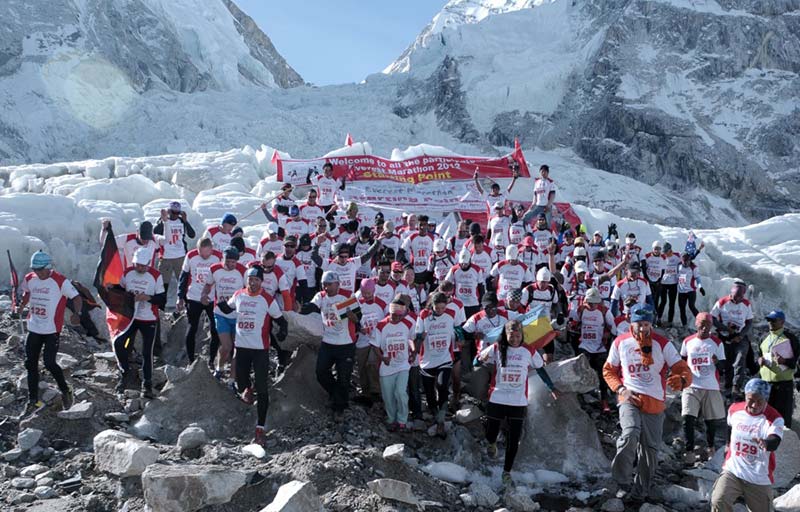
Race day. Runners set off from Everest Base Camp and follow the trekking trail in reverse — through Gorak Shep, Lobuche, Dingboche’s turnoff, Pheriche, and Tengboche — finishing 42.195 km later in Namche Bazaar. With roughly half the oxygen available at sea level and a technical, rocky trail, most finishers take significantly longer than a standard road marathon.
With the race behind you, today is largely about descent and recovery. Dropping altitude quickly brings noticeable relief, and the pace back down the valley feels easy compared to the days before.
The final trekking day retraces familiar ground back to Lukla, giving time to reflect on the past two weeks before flying out. A celebratory dinner with your guide and crew is a common way to mark the end of the trek.
A short flight returns you to Kathmandu, where a hot shower, proper bed, and free evening await. Many runners use this day for souvenir shopping or a relaxed dinner in Thamel.
Transfer to Tribhuvan International Airport for your flight home, with memories — and sore legs — to match one of the most extreme finish lines in the world.
Total distance covered: Roughly 130+ km of trekking plus the 42.195 km marathon itself, spanning 18 days from Kathmandu and back.
1. What is the Tenzing Hillary Everest Marathon?
The world’s highest marathon, run from Everest Base Camp to Namche Bazaar.
2. When is it held?
Every year on May 29, Everest Day.
3. Why May 29?
It marks the anniversary of Tenzing Norgay and Edmund Hillary’s first Everest summit in 1953.
4. When did the race start?
2003 — 2027 will be its 25th edition.
5. What’s the starting altitude?
About 5,364 meters (17,500 feet) at Everest Base Camp.
6. Where does it finish?
Namche Bazaar, at 3,440 meters.
7. How long is the race?
42.195 km — a full marathon distance.
8. Are there shorter distances?
Yes — a 21K half marathon and a 60K+ ultra category too.
9. What time does the race start?
7:00 AM sharp from Base Camp.
10. Is there a cutoff time?
Yes, 16 hours to finish.
11. Who holds the course record?
Deepak Rai, at 3 hours 28 minutes, set in 2006.
12. How many runners join each year?
Around 250, from 20+ countries.
13. Do I need climbing skills to run it?
No — it’s a trail race, not a technical climb.
14. Is the entry fee refundable?
No, entry fees are non-refundable.
15. Do I need a trekking package to join?
Yes — almost all runners join via a multi-day trek-and-race package for safe acclimatization.
16. Is it harder than a normal marathon?
Yes, by far — thin air and rocky trail make it far tougher than the distance suggests.
The Tenzing Hillary Everest Marathon isn’t really about a finish time. It’s about what happens between Base Camp and Namche Bazaar – thin air, aching legs, sweeping Himalayan views, and a finish line earned the hard way. Whether you’re a competitive trail runner chasing a genuinely rare achievement or an adventure traveler drawn to the story of Hillary and Tenzing, this is a race that rewards preparation and respects the mountain. With the right acclimatization plan and a support team who know the Khumbu well, it’s one of the most demanding – and most rewarding – finish lines in the world.
There is a moment on every Everest trek when your legs have an opinion. For most people, it arrives
Continue Reading
If you are asking how difficult the Everest Three Passes Trek is, the honest answer is this: it is t
Continue Reading
My name is Peng Chang, and I travelled to Nepal from Malaysia with a small group of friends. Before
Continue Reading
In this story Why I Chose Everest Base Camp My name is Chyling, and I come from Malaysia, a country
Continue Reading
Ask anyone who has finished the Annapurna Circuit which day they remember most, and the answer is al
Continue Reading
Introduction Kathmandu doesn’t ease you in. You step out of the airport into a chorus of horns
Continue Reading