
3 Oct 2026 12 min to read

My name is Chyling, and I come from Malaysia, a country where the highest thing most of us climb on an ordinary day is a staircase in a shopping mall. Cold is something we know from air conditioning. So when I told my friends I was going to walk to the foot of Mount Everest, the reaction was somewhere between admiration and open disbelief.
The idea had followed me around for years. I would see a photo of prayer flags snapping in front of a wall of white peaks and think, one day. In 2024 I stopped saying “one day.” I picked November, when the post-monsoon sky is at its clearest and the trails are dry, and I started to look for the right people to go with.
I spent a few weeks reading reviews and comparing itineraries. Many companies promised the same thing in the same words. What drew me to Safe Holiday Adventure Pvt. Ltd was how they answered questions. I asked about altitude, about whether a first-time trekker from a tropical country could realistically manage it, and about what happens if someone feels unwell. The replies were direct and unhurried. Nobody tried to sell me a dream. They explained the acclimatization schedule, the days that would be hard, and the days that would be kind.
Within a week I had confirmed the booking for a 13-day Everest Base Camp trek starting in the second week of November 2024. Looking back, trusting that team was the best decision of the whole trip.
The flight from Kuala Lumpur to Kathmandu took about five hours. I spent most of it pressed against the window. As we crossed into Nepal the cloud thinned and a long white line appeared along the northern horizon. Nobody had to tell me what I was looking at. The Himalayas look unreal from the air, like a second sky made of stone and ice.
Kathmandu on arrival was loud, dusty, and wonderful. Horns, motorbikes, incense, and a thousand small shops. It felt about as far from the quiet of the mountains as a place can be, which made the contrast I was about to experience even stronger.

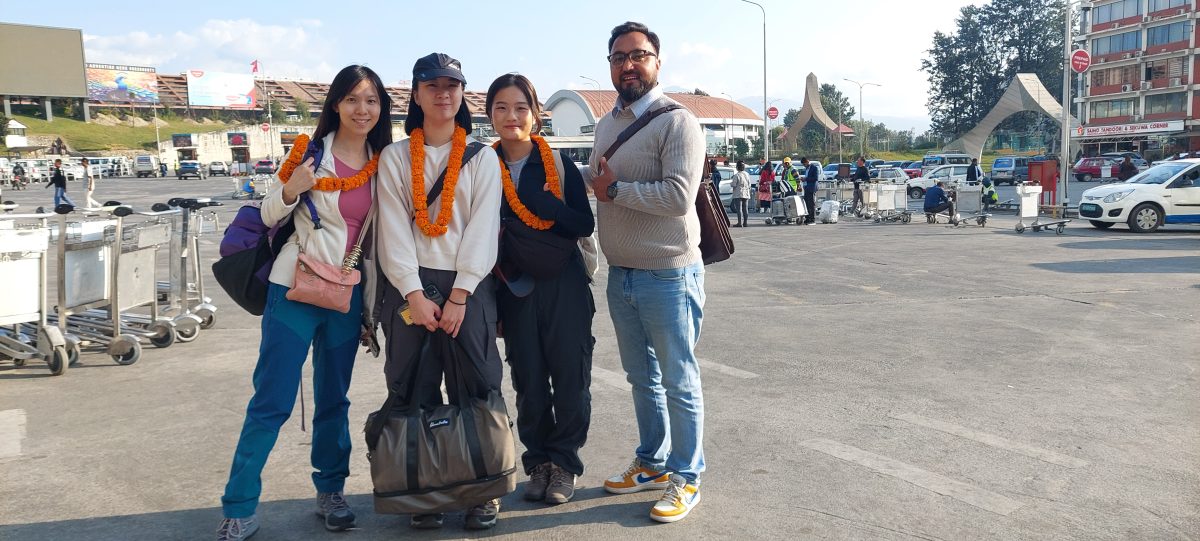
Outside the arrivals hall, among the crowd of drivers holding signs, I found a man holding a card with my name and a calm smile. This was Santosh Gauli, the guide who would be with me from that moment until the day I flew home.
He greeted me with a namaste and took my heavy bag before I could object. On the ride to my hotel in Thamel he pointed out temples and explained the city’s moods, without making a lecture of it. That evening we sat over tea and he went through everything: the early start, the flight to Lukla, how the first days would feel, and one rule he repeated several times with a grin: bistarai, bistarai. Slowly, slowly.
He also checked my gear, gently. He noticed my jacket was not warm enough for the upper sections and sent me to a shop in Thamel to find a proper down layer. I would be grateful for that in a few days.

The alarm went off in the dark. In the busy autumn season, Lukla flights operate from Manthali airport in Ramechhap rather than from Kathmandu, so we left the hotel in the small hours and drove several winding hours through the hills as the sky slowly turned grey.
The flight to Lukla was the shortest and most dramatic of my life. The little plane dips between green ridges, and then the runway appears, tilted uphill and ending at a mountain wall. I held the seat in front of me. Santosh, who has done this many times, was reading the safety card with total calm. We landed with a small bump and a big exhale from everyone on board.
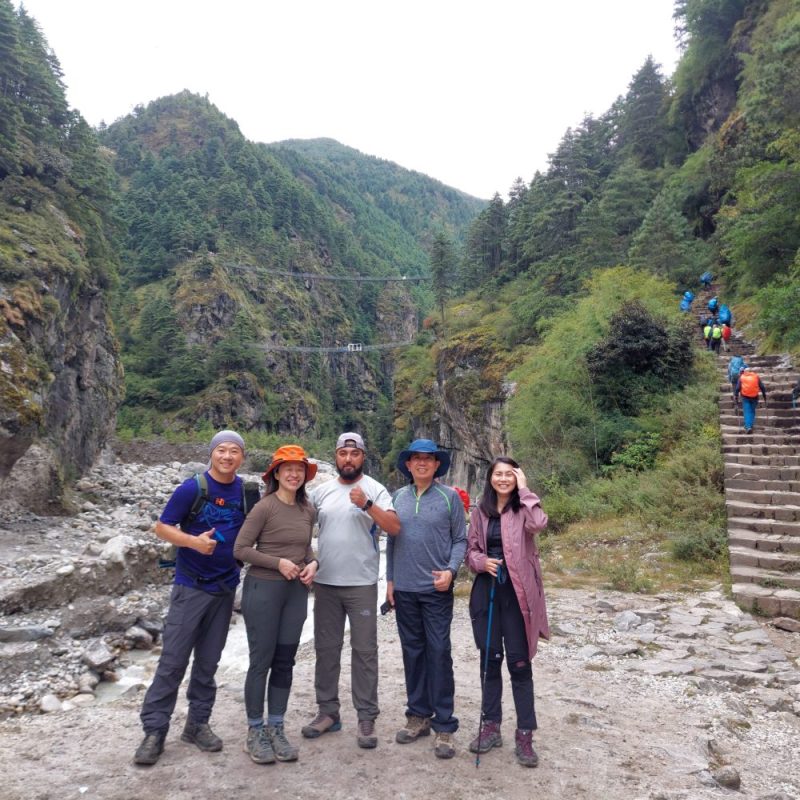
At Lukla, at about 2,860 metres, our porter joined us, and we began walking to Phakding, a gentle first day mostly downhill along the Dudh Koshi river. I crossed my first suspension bridge, with prayer flags above and a loud turquoise river far below. The air was cool and smelled of pine. It was the first moment I really believed I was in the Himalayas.
This was the first day that tested me. The trail follows the river, enters Sagarmatha National Park near Monjo where Santosh handled the permit checks, and then drops to the river before the climb to Namche Bazaar.
Everyone who has walked this route talks about the final stretch, and for good reason. After crossing the high Hillary Suspension Bridge, the trail turns steeply upward for what feels like forever. My lungs burned and my legs complained. Santosh walked half a step behind me, never rushing me, but quietly watching my breathing. Whenever I stopped, he stopped, pointed at a view, and made the pause feel intentional.
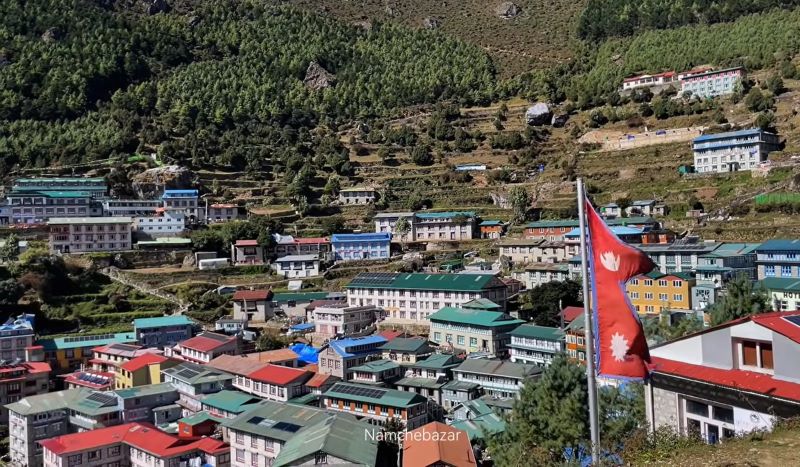
Then, through the trees, Namche appeared: a horseshoe of stone houses stacked up a hillside, glowing in late afternoon light. At around 3,440 metres, it felt like arriving at a small mountain capital. I drank my weight in ginger tea and ate a plate of momos.
A rest day sounds lazy, but acclimatization is the heart of this trek. Santosh explained that the body adapts at altitude while you rest, and that the old rule of climbing high and sleeping low is what keeps people safe.
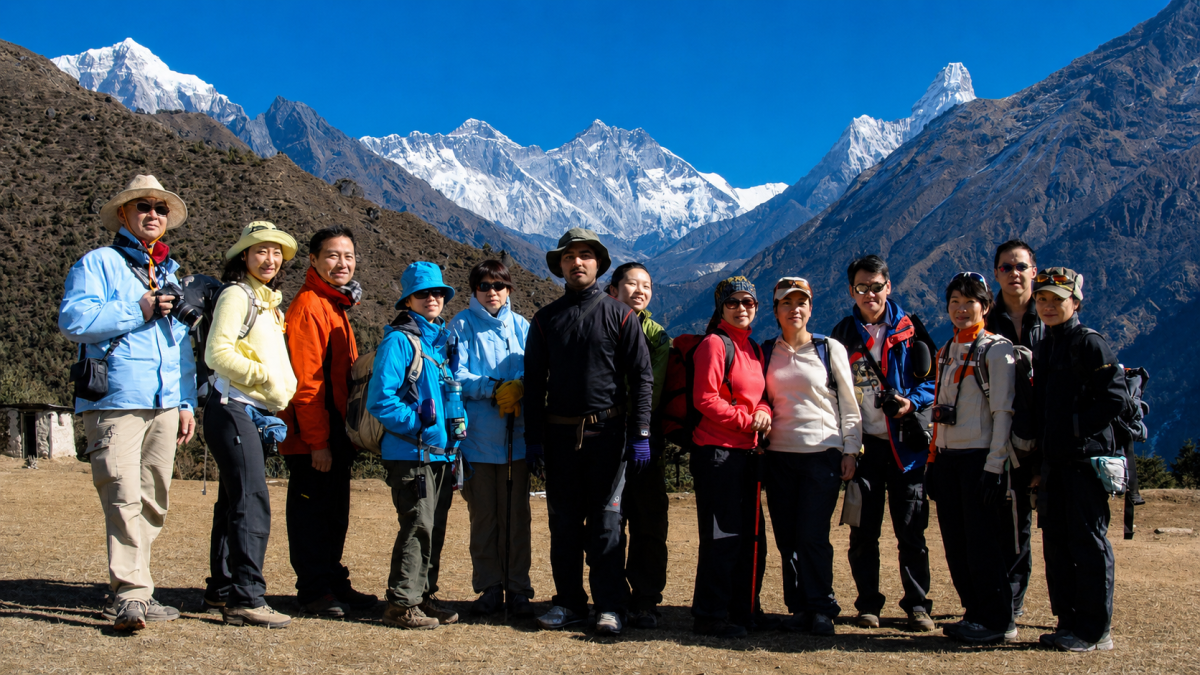
So we walked up to the Everest View Hotel above Namche, and there, at last, was Everest itself, a dark, wind-scoured pyramid next to the great wall of Lhotse and Nuptse. It was far away and small, and I still got goosebumps. We continued to Khumjung, a village of stone walls and potato fields, and returned to Namche for a slow afternoon of exploring the bakeries and shops.
That evening Santosh used a pulse oximeter on my finger. This became a daily ritual from here on. He wrote down numbers, asked about headaches and appetite, and told me honestly what he was seeing. I never felt like a patient. I felt looked after.
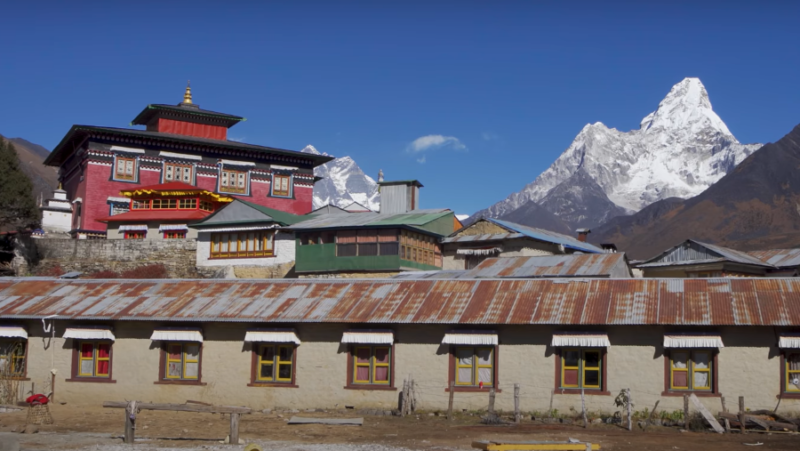
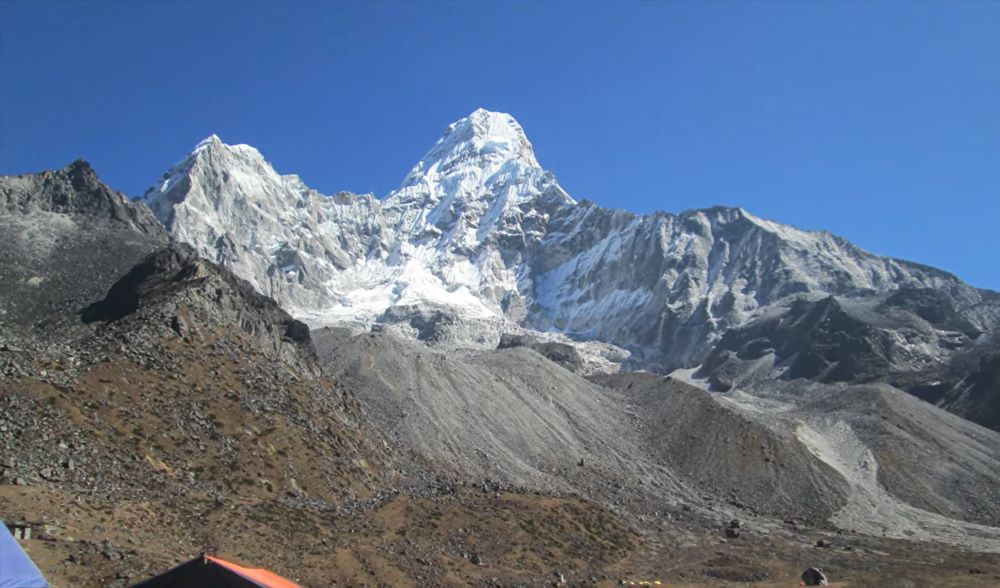
The morning trail was one of the loveliest of the trek, a high path above the valley with the peaks of Ama Dablam, Thamserku, and Kantega across the gorge. Ama Dablam in particular caught my attention. It is shaped like a mother with outstretched arms, and it stayed in view, changing shape with the angle, for days.
After a long descent to the river and an even longer climb, we reached Tengboche at about 3,860 metres. Its monastery sits on a ridge with the mountains wrapped around it. In the late afternoon we slipped inside for the evening prayers. The low chanting, the long horns, and the butter-lamp smell, mixed with the cold from the stone floor, are impossible to describe properly. Santosh bowed quietly at the entrance. I followed, and sat with my hands in my lap, feeling very far from home and strangely calm.
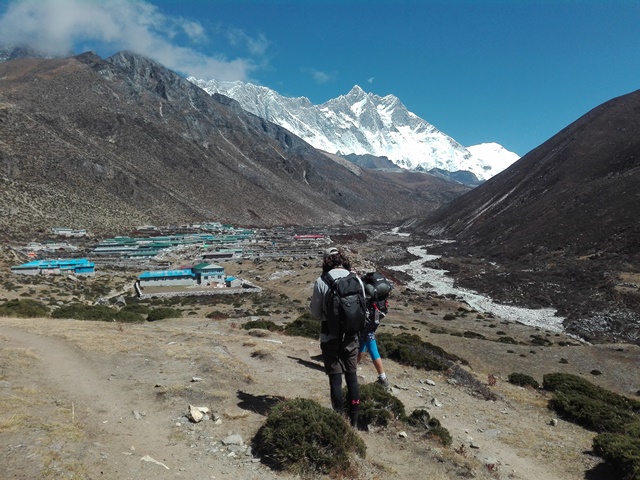
Past Tengboche, the forest ends and the land opens out. The trees shrink, the air thins, and the horizon grows. We crossed the river at Pangboche and climbed on to Dingboche at around 4,410 metres, a village of stone-walled fields lying beneath a huge wall of peaks.
The nights were cold here, properly cold, with ice inside the window. This was my first real night with a headache, mild but persistent. Santosh checked my oxygen reading, made me drink more water, and told me to rest, not to worry. By morning, I felt better.
Day 7 was the second acclimatization day. We climbed the ridge above Dingboche toward Nangkartshang, and I looked back at the whole valley spread out beneath me, tiny houses and walls against giant slopes. The view across to Makalu and Lhotse was beyond anything I had imagined. I sat on a rock and ate a chocolate bar. It remains one of my favorite moments of the entire trek.
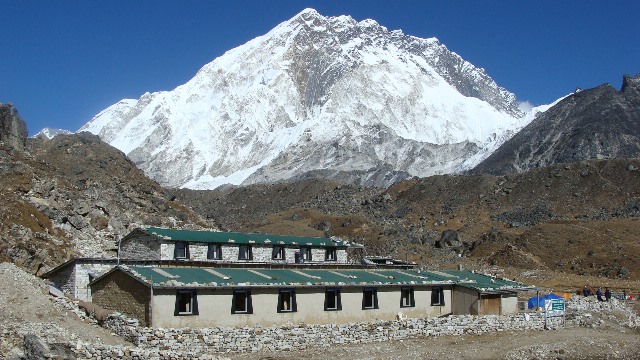
The trail to Lobuche is stark and beautiful. At Thukla, a high pass, a row of stone memorials stands for climbers who never came home. Prayer flags move above them and the wind carries a particular quietness. Santosh touched one of the stones and said a short prayer, and I stood next to him without speaking. It put the whole mountain in a different perspective.
Lobuche, at about 4,910 metres, is not a pretty place. It is a cluster of simple lodges in a cold, rocky valley. But the guesthouse was warm in the dining room, the dal bhat was hot, and the people around the stove, from all over the world, were swapping stories in the soft light. I wore every layer I owned to bed.
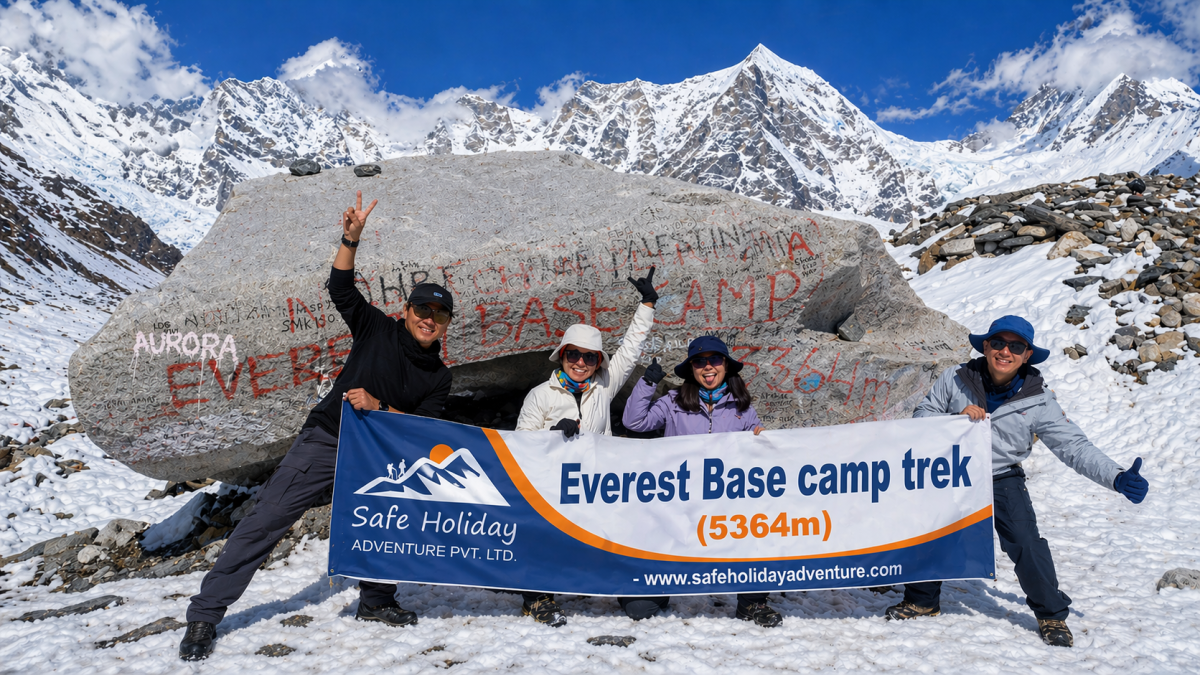
This was the day. We left early, walked along the rocky moraine, and reached Gorak Shep at about 5,164 metres, where we dropped our bags and rested briefly. Then we continued toward Everest Base Camp.
The trail climbs up and over bumpy glacier moraine, with the Khumbu Glacier groaning and cracking beneath the rocks. I walked slowly, concentrating on my breathing, one step, then another. Santosh kept me at a pace where I could talk. When I got quiet, he checked on me. When I got emotional, he waited.
Then we arrived. At 5,364 metres, there is a pile of rocks, a cluster of prayer flags, and a sign marking Everest Base Camp. You cannot see the summit of Everest from here, since the surrounding ridges hide it. What you see instead is the tumbling blue-white wall of the Khumbu Icefall and the colorful tents of expedition teams, depending on the season. I stood there, shaking and half laughing and half crying, in front of the biggest mountain on Earth. Santosh took my photograph, then, quietly, hugged me. We walked back to Gorak Shep in silence.

The alarm went off at 4 a.m. It was around minus fifteen degrees outside. I put on everything I had, took a few bites of breakfast, and stepped out into total darkness with a headlamp and a very serious attitude.
The climb up Kala Patthar is steep, short, and brutally cold. Each step felt heavy. I stopped often. Santosh stayed beside me, offering encouragement whenever I needed it, and reminding me, once again: bistarai, bistarai.
At 5,545 metres, I reached the top just as the sun was rising. The light spilled over the ridge and the entire Himalayan range lit up, one peak after another. From Kala Patthar, Everest is finally visible, a dark pyramid rising behind Nuptse, with a plume of snow blowing from its summit. It was the highest I had ever stood in my life. I did not speak for a long time.
Afterward, we walked down to Gorak Shep, had breakfast, and began the descent to Pheriche. The air got thicker with every step, and I started to feel stronger.
The way down is its own journey. We retraced our steps, passing the same villages, but everything felt different. The same trail that had made me gasp now felt easy. Rhododendron forests returned, birds sang, and the air felt thick and generous. I kept noticing how much I had changed in a few days.
We spent a night in Namche, where I treated myself to a hot shower and a slice of apple pie, then walked the last long stretch to Lukla. That evening we celebrated with Santosh and our porter, sharing stories and laughing at the small mishaps of the trip. I could not stop thanking them.
The next morning we flew back to Kathmandu, and the Himalayas slid by outside the window one last time.
Looking back, what stays with me is not only the view from Kala Patthar or the moment at Base Camp. It is the whole journey: the people, the quiet, the cold, the kindness.
The Everest Base Camp trek is hard, and I will not pretend otherwise. There were days I wanted to quit. But with proper acclimatization, a slow pace, good gear, and the right team, it is possible for an ordinary person from a tropical country to do it.
Santosh Gauli was the reason it felt safe. He was with me from the airport in Kathmandu until the flight home, and he never left my side. He read my body better than I could, managed every permit and lodge, and shared his culture with warmth and humor. Safe Holiday Adventure Pvt. Ltd lived up to its name, and I never felt rushed, neglected, or alone.
If you are dreaming of Everest Base Camp, start planning. The mountain will wait, but you will not always have the chance.
Chyling, Malaysia, trekked in November 2024
Travelling to Nepal and exploring the Himalayas had been one of our biggest travel dreams. When nine
Continue Reading
Imagine this. You are standing in Namche Bazaar, the horseshoe-shaped Sherpa town at 3,440 metres, w
Continue Reading
Namche Bazaar is where the Everest trail makes its biggest decision. Most trekkers turn right toward
Continue Reading
Nepal is famous for Mount Everest, the Annapurna Himalayas, ancient temples, traditional villages, a
Continue Reading
There is a moment at Annapurna Base Camp when the sun touches the rim of the sanctuary and every pea
Continue Reading
There is a moment on the Annapurna Circuit that every trekker thinks about for days. It happens in t
Continue Reading