
15 Oct 2026 11 min to read
There is a moment on every Everest trek when your legs have an opinion. For most people, it arrives around Lobuche, somewhere between a cold teahouse bed and the thought of a six-hour walk back down. The luxury Everest Base Camp trek with helicopter return is built around that moment. You still walk up, earn the views, and stand beneath the Khumbu Icefall. But you swap the long descent for a short flight, and you sleep in lodges that treat warmth as a priority rather than a bonus.
So is it worth the investment? The honest answer depends on what you value. This guide walks through the journey the way you would live it, so you can judge the experience, the real costs and the trade-offs before you commit.
The word luxury gets used loosely in Nepal, so it helps to be precise. On this kind of trip, it usually means four things working together.
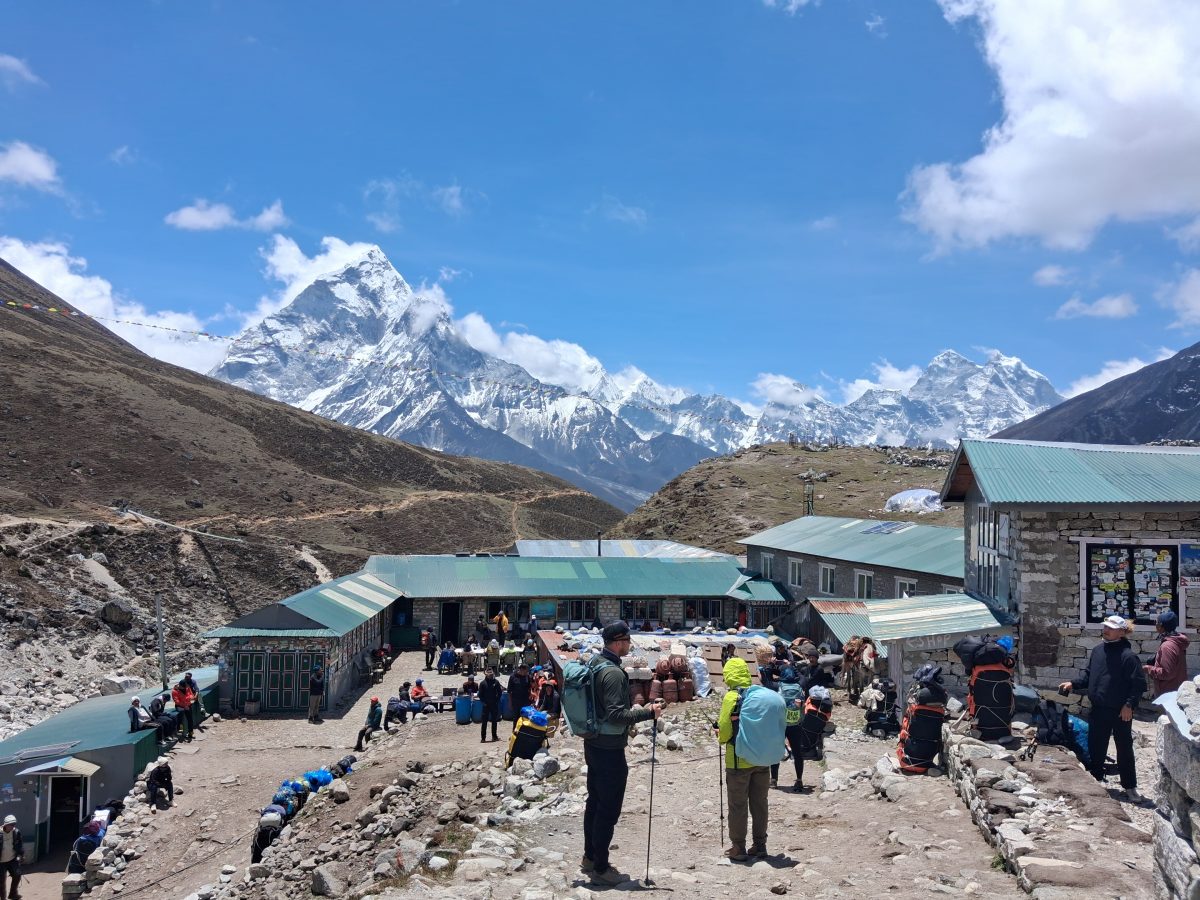
First, better rooms. Instead of a basic teahouse with a thin wall and a shared toilet down the corridor, you stay in lodges built for comfort, with attached bathrooms in the lower sections, thicker bedding, heated dining rooms and better food. Second, a smaller, slower pace, often with a private guide and porters, so nobody rushes you. Third, flexibility, meaning spare days built into the plan and a guide who watches how you feel rather than the clock. Fourth, the helicopter return, which compresses the exhausting walk back into a scenic flight.
It is still a trek. Nobody carries you to base camp. The comfort simply surrounds the effort instead of replacing it.
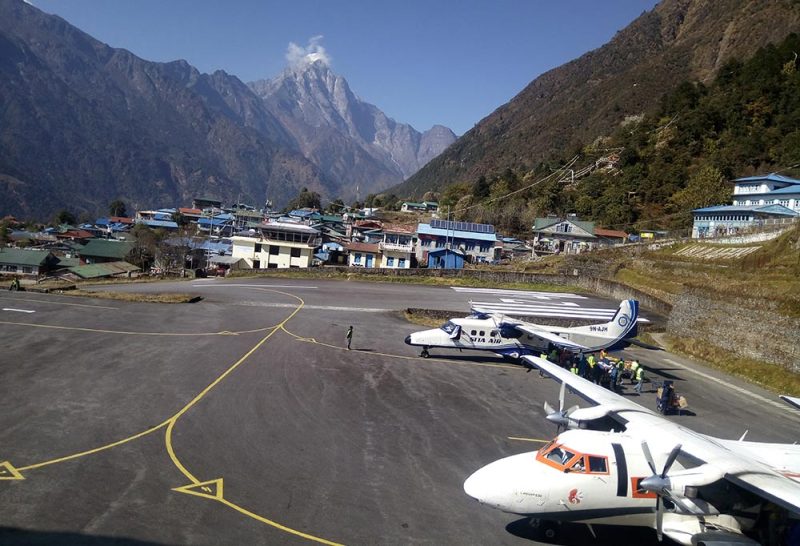
The adventure begins with an early flight from Kathmandu to Lukla, a small airstrip cut into a mountainside at around 2,860 metres. The runway slopes uphill, the mountains close in on both sides and the landing is memorable. On a luxury itinerary, your guide meets you with tea, hands your bags to the porters and starts you off on an easy first walk to Phakding.
This gentle start matters. Day one is short on purpose, giving your body time to adjust before the real climbing begins.
The path to Namche Bazaar crosses long suspension bridges strung with prayer flags, then climbs steeply through pine forest. Namche, at roughly 3,440 metres, is the Sherpa capital of the Khumbu. It is also where a good luxury plan shows its value.
You spend two nights here. The rest day is not a day off. You climb higher to a viewpoint, then come back down to sleep, which is the classic way to help your body adapt. Between walks, you can browse bakeries, climbing shops and the small museum, and some travellers fit in a coffee with a first glimpse of Everest, Lhotse and Ama Dablam from the ridge above town.
Beyond Namche the trail turns into a long traverse above the Dudh Koshi river. The route drops to the river, then climbs to Tengboche at about 3,870 metres, home to the region’s most important monastery. If your timing is right, you can step into the prayer hall while the monks chant, with Ama Dablam rising directly behind.
From here the trees thin out and the valley opens into wide, windswept meadows. Dingboche, at around 4,410 metres, brings another acclimatization day. You will feel the air thinning. This is where a private guide earns their keep, checking oxygen levels, watching for headaches and adjusting the plan without a fuss.
The last stretch is the hardest and the most dramatic. You pass memorials to climbers who never came home, then walk beside the moraine of the Khumbu Glacier toward Lobuche at about 4,940 metres. Gorak Shep, the last settlement at roughly 5,160 metres, sits on a frozen lakebed with Pumori looming above.
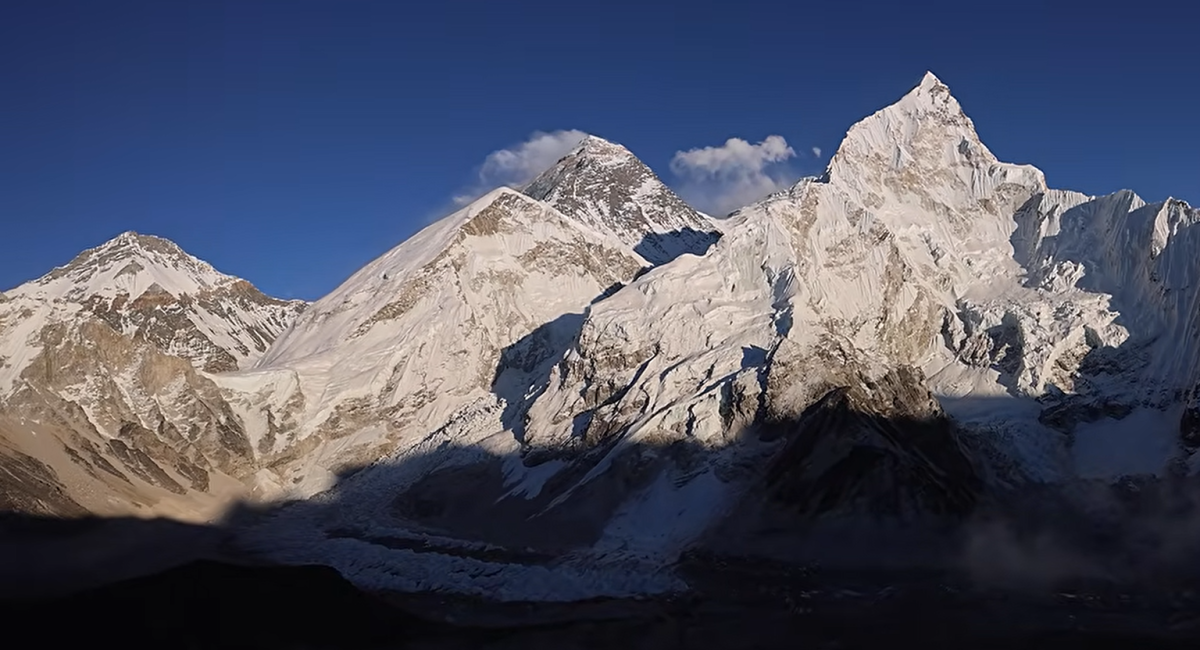
From here, you walk to Everest Base Camp itself, at about 5,364 metres. The camp is a field of tents and boulders at the edge of the ice, with prayer flags snapping in the wind. Everest is not visible from base camp, which surprises many people. For the real view, you climb Kala Patthar, about 5,545 metres, usually at sunrise the next morning. That is the moment the whole trip is built around: Everest, Nuptse and Lhotse turning gold in the first light.
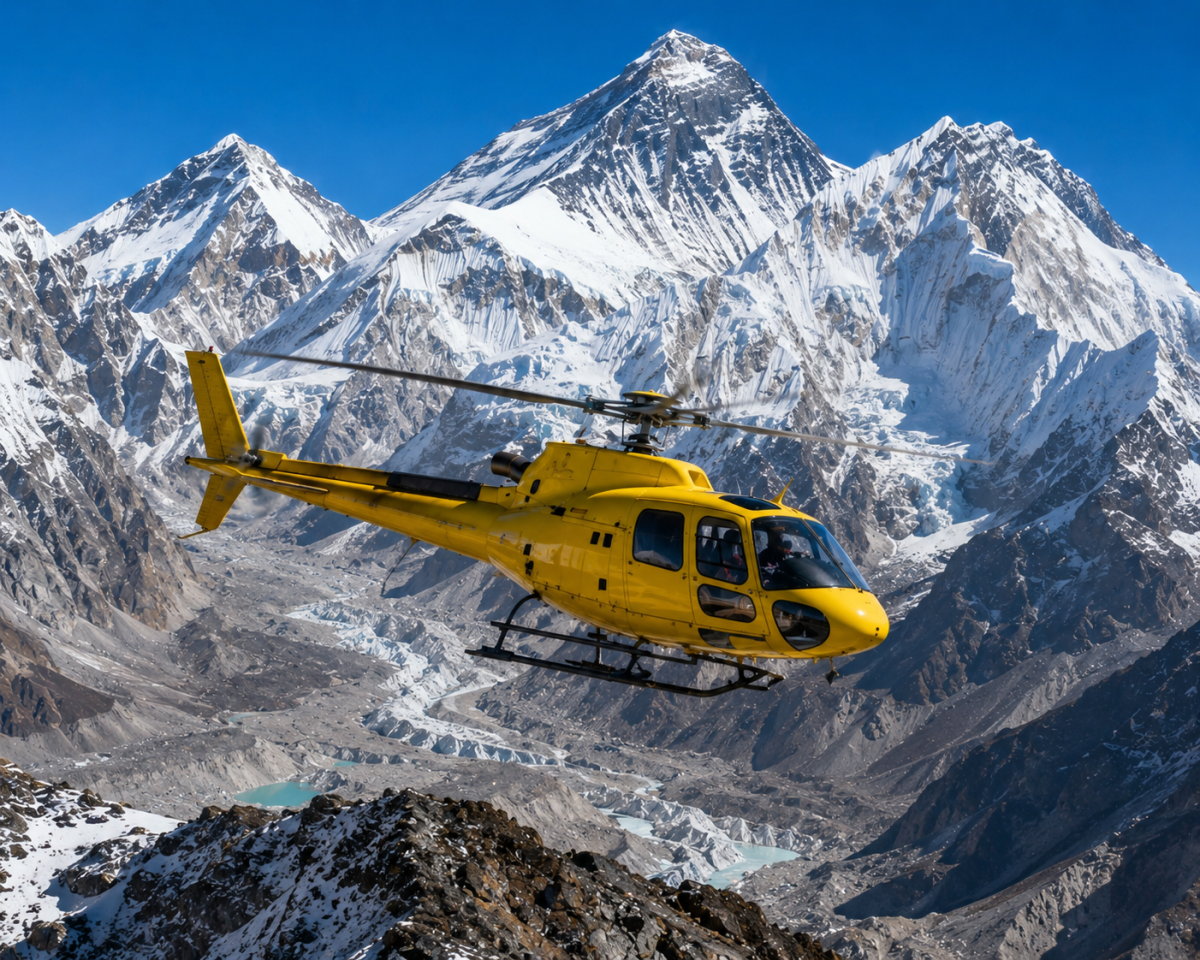
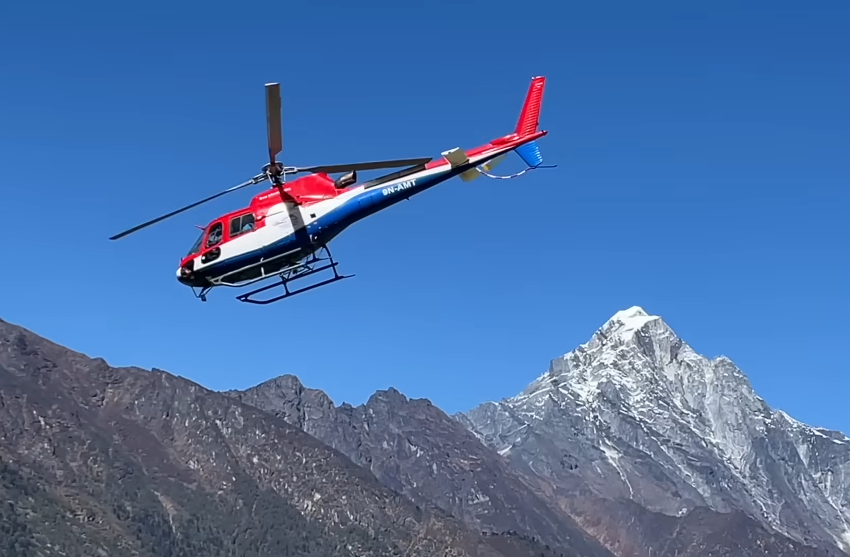
After sunrise at Kala Patthar, you walk back to Gorak Shep for breakfast. Then, instead of three or four days of descent, a helicopter collects you and flies you down the valley. Depending on your plan and the weather, you land either in Lukla to connect with a flight to Kathmandu, or you fly all the way back to the capital.
The flight itself is a highlight. You pass over the same glaciers, ridgelines and villages you spent days walking through, now seen from above in under an hour. Many travellers say the descent by air gives them a perspective on the scale of the Himalayas that the trail cannot.
It also does something practical: it protects your schedule. Anyone who has tried to fly out of Lukla knows that delays happen, because cloud and wind can ground aircraft for a day or two. A helicopter, which flies under different rules and can operate from higher altitude, makes it far less likely that a weather delay will cost you an international flight home.
A word of honesty is needed here. The helicopter is not a rescue button, and it does not replace acclimatization on the way up. You still ascend gradually, and the flight simply makes the way down faster. Flights depend on weather, usually flying best in the morning, so a good operator always builds in a backup day.
This is the question that matters, so let us treat it fairly.
A luxury Everest Base Camp trek with helicopter return costs significantly more than a standard trek. Prices vary by operator, season, group size and lodge standard, and helicopter charter rates in particular change from year to year. Rather than quoting a number that may be out of date, it is better to ask your operator for a written quote showing exactly what is included, covering lodges, permits, guide and porter, flights and the helicopter charter.
What you are really paying for falls into three categories.
Time. A standard Everest Base Camp trek takes around 12 to 14 days. With a helicopter return, you can shorten the trip by several days. For a busy professional with limited leave, those saved days can be the difference between doing the trek and not doing it.
Comfort and recovery. Better beds, warmer rooms and good food make a real difference at altitude. Sleep is the first thing to suffer above 4,000 metres, and a warm, quiet room helps you recover for the next day.
Certainty. The helicopter reduces the risk of missing a connecting flight because of weather. If you have a tight international itinerary, that peace of mind has genuine value.
On the other side of the ledger, the trek will still be physically demanding. The luxury does not remove the altitude, the cold or the long days of walking. If you were hoping that money would buy an effortless experience, it will not.
This style of trek suits you if you are short on time, if you want to protect your knees from the long descent, or if you are travelling with a partner or family member who is less confident about rough conditions. It also suits people celebrating an anniversary, a milestone birthday or a long-planned dream trip, where comfort is part of the point.
It also works well for travellers who are fit but not seasoned hikers. A private guide and flexible pace let you enjoy the journey without the pressure of keeping up with a group.
If you love the slow rhythm of the trail, you may feel that flying out misses something. The walk back down is quieter than the walk up, and many trekkers treasure those final days of thicker air, easier breathing and conversations with fellow travellers. If your budget is tight, a well-run standard trek still delivers the same mountain views for a much lower cost.
Neither choice is wrong. They are two different ways of experiencing the same mountain.
A few decisions will shape how well your trip goes.
Pick your season carefully. Spring (March to May) and autumn (late September to November) offer the clearest skies and the most stable weather. Winter is quieter but much colder, and the monsoon months bring cloud that can disrupt flights.
Train before you go. Aim for several months of hiking, stair climbing and cardio. Hills with a loaded backpack are the best preparation. Fitness will not prevent altitude sickness, but it will make the days more enjoyable.
Ask the right questions. Does the quote include permits, domestic flights, lodges, meals and the helicopter charter? What happens if the helicopter cannot fly? Is there a spare day built in? Do the guides carry oxygen monitoring equipment and have first-aid training?
Check your insurance. Make sure your travel policy covers trekking up to 5,500 metres and helicopter evacuation. This is not optional.
Respect the pace. Drink plenty of water, tell your guide immediately about headaches or nausea, and never ascend with symptoms. The mountain will still be there tomorrow.
1. What is an Everest Base Camp trek with helicopter return?
You trek up to Everest Base Camp and Kala Patthar on foot, then fly back by helicopter instead of walking down. It saves several days and spares your knees.
2. How many days does it take?
Usually 9 to 12 days, depending on how many acclimatization days are included.
3. Where does the helicopter pick you up?
Most flights leave from Gorak Shep after Kala Patthar. Some itineraries use Lobuche or Pheriche instead.
4. Where does the helicopter land?
Either Lukla, where you take a short flight to Kathmandu, or directly in Kathmandu. Your operator will confirm this beforehand.
5. Is the helicopter return safe?
Yes. Helicopter flights in the Khumbu are routine and the pilots are experienced in mountain conditions. Flights are weather-dependent, so delays can happen.
6. Does the helicopter replace acclimatization?
No. You still walk up gradually and take rest days. The helicopter only speeds up the descent.
7. How much does it cost?
The price depends on the operator, lodge standard, group size and season. The helicopter charter is usually the biggest extra cost, so ask for a written quote.
8. Can I share the helicopter with others?
Yes. Charters carry several passengers, so sharing with your group or other trekkers lowers the cost per person.
9. What if bad weather stops the helicopter?
Flights are rescheduled for the next suitable window, which is why a spare day should be built into your plan.
10. What is the best season for this trek?
Spring (March to May) and autumn (late September to November) offer the clearest skies and most stable weather.
11. How fit do I need to be?
Good general fitness is enough. You will walk 5 to 7 hours a day at altitude, so train with hiking and cardio beforehand.
12. Is this trek suitable for beginners?
Yes, if you are healthy and well prepared. A private guide and flexible pace make it manageable for first-time trekkers.
13. Are the lodges really luxury?
In the lower and mid sections, comfortable lodges offer better beds, heating and food. Higher up, even the best lodges stay simple because of the altitude and remote location.
14. Does the package include insurance?
Usually not. You need your own travel insurance covering trekking to 5,500 metres and helicopter evacuation.
15. Is it worth the extra cost?
It is worth it if you value saved time, comfort and a smoother return. If you prefer the traditional journey or have a tight budget, a standard trek gives you the same mountain views.
If your goal is to stand beneath Everest with a warm bed waiting for you, to save days on your calendar and to avoid the knee-grinding descent, then yes, this trip can be very much worth the investment. You pay for time, comfort and certainty, and you still earn the mountain with your own legs.
If you value the full, slow traditional journey or are working with a tight budget, a standard trek will give you the same summit views and the same sense of achievement.
The best choice is the one that matches how you want to remember the trip. Whichever you choose, start planning early, ask detailed questions and give yourself the gift of time on the trail. Everest has a way of rewarding the people who arrive prepared.
If you are asking how difficult the Everest Three Passes Trek is, the honest answer is this: it is t
Continue Reading
My name is Peng Chang, and I travelled to Nepal from Malaysia with a small group of friends. Before
Continue Reading
In this story Why I Chose Everest Base Camp My name is Chyling, and I come from Malaysia, a country
Continue Reading
Ask anyone who has finished the Annapurna Circuit which day they remember most, and the answer is al
Continue Reading
Introduction Kathmandu doesn’t ease you in. You step out of the airport into a chorus of horns
Continue Reading
Every Everest Base Camp trekking package includes a line item for “guide” and “por
Continue Reading