
2 Apr 2019 8 min to read
Not everyone has two weeks to spare or wants to climb above 5,000 metres. If you want to see Mount Everest, walk among Sherpa villages and feel the Himalaya without a hard push, the Everest Panorama Trek is the answer. In about a week you fly into the mountains, climb to a famous viewpoint, visit a mountain monastery and walk back down with a camera full of peaks.
This guide explains the Everest Panorama Trek price for 2026/2027, what the money covers, the day-by-day route, the top highlights, the best season and the practical details that make the trip smooth. It ends with 20+ answers to the questions trekkers ask most.
The Everest Panorama Trek, sometimes called the Everest View Trek, is a short walk in the lower Khumbu region of Nepal. It follows the first part of the Everest Base Camp route, then stops at Namche Bazaar, Khumjung and Tengboche rather than continuing higher.
Because you stay under roughly 3,900 metres, the days are shorter and the air is easier to breathe. You still get close views of Everest, Lhotse, Nuptse and Ama Dablam, plus the culture of the Sherpa people who live here.
It suits first-time trekkers, families, older travellers, people short on time, and anyone who wants to test their altitude response before a bigger trek.
Prices vary by operator, season, group size and trip length. Looking across current offers, most 7 to 10 day packages sit around US$1,100 to US$1,450 per person. Longer 11 to 12 day versions, which add rest days or extra villages, can run from about US$1,200 to US$1,900.
Use these figures as a planning range and confirm the final price directly with the company.
| Day | Plan | Altitude |
|---|---|---|
| 1 | Arrive in Kathmandu, trip briefing | 1,400 m |
| 2 | Fly to Lukla, walk to Phakding | 2,610 m |
| 3 | Phakding to Namche Bazaar | 3,440 m |
| 4 | Hike to Everest View Hotel, descend to Khumjung | 3,780 m |
| 5 | Khumjung to Tengboche | 3,860 m |
| 6 | Tengboche back to Namche Bazaar | 3,440 m |
| 7 | Namche Bazaar to Lukla | 2,840 m |
| 8 | Fly to Kathmandu | 1,400 m |
| 9 | Departure or spare day | – |
Shorter 7-day plans trim the Khumjung stay. Longer plans add an extra acclimatization night or a different route back.
The 35 to 45 minute flight is a thrill on its own. You skim over forested ridges and terraced farmland before landing on a short, sloped runway tucked into the mountainside.
Namche is the main Sherpa town of the Khumbu. Its stone buildings climb a steep amphitheatre, and it has bakeries, cafes, gear shops and a weekly market. It is also where your body gets used to the altitude.
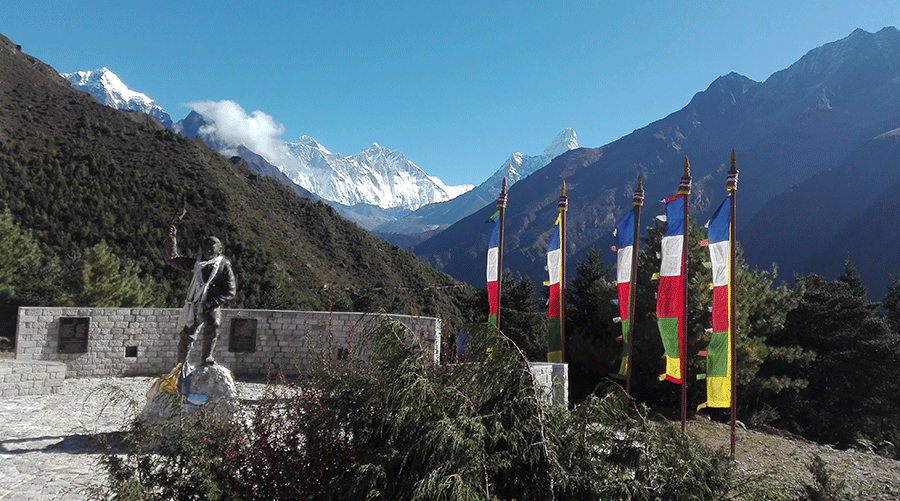
The short climb above Namche to this hotel, at about 3,880 metres, is the reason the trek is called a panorama trek. It has been recognised as one of the world’s highest-placed hotels. Sit on the terrace with a hot drink and watch Everest, Lhotse and Ama Dablam appear in the sunlight.
These sheltered villages feel quieter than Namche. Khumjung is known for the school founded by Sir Edmund Hillary and a monastery with a famous yeti scalp. The lanes are lined with stone walls, potato fields and yak pastures.
At about 3,860 metres, Tengboche is the spiritual centre of the region. The monastery sits on a forested ridge with Ama Dablam rising behind it. Stay overnight to hear morning prayers and catch first light on Everest.
The park is a UNESCO World Heritage Site. Look for Himalayan tahr, musk deer and the colourful danphe pheasant, Nepal’s national bird, among rhododendron and pine forest.
You cross high steel bridges over the Dudh Koshi river, pass prayer wheels and mani walls, and meet yak caravans on the trail. Teahouses welcome you with warm food and friendly conversation.
It is rated easy to moderate. Most days involve 3 to 6 hours of walking, and the highest point is the Everest View Hotel at about 3,880 metres. The steepest effort is the climb into Namche Bazaar. No technical skills are needed.
Altitude sickness is less likely than on Base Camp treks, but it can still happen above 3,000 metres. Walk slowly, drink plenty of water and tell your guide immediately if you feel unwell.
For preparation, do 4 to 6 weeks of walking, stair climbing or light cardio before you travel.
Absolutely. For about a week and a modest budget, you get Everest views, Sherpa culture, historic monasteries and genuine Himalayan trails. It is also an excellent first step toward longer treks like Everest Base Camp.
Safe Holiday Adventure Pvt. Ltd can arrange your Everest Panorama Trek with experienced guides, flexible dates and a pace that suits your group.
1. What is the Everest Panorama Trek?
A short Khumbu trek to Namche, Khumjung and Tengboche with strong views of Everest.
2. How much does it cost?
Most 7 to 10 day packages cost about US$1,100 to US$1,450 per person.
3. How many days does it take?
Usually 7 to 10 days, with 9 days most common.
4. How high does the trek go?
About 3,880 metres at the Everest View Hotel.
5. Is it suitable for beginners?
Yes. It is easy to moderate and needs no technical skills.
6. Can I see Mount Everest?
Yes, on clear days from the Everest View Hotel, Khumjung and Tengboche.
7. How is it different from Everest Base Camp?
It is shorter, lower and cheaper, and it does not reach Base Camp.
8. Is altitude sickness a risk?
The risk is lower than on higher treks, but you should still acclimatize.
9. What is the best season?
September to November and March to May.
10. Can I do it in winter?
Yes, with warm clothing. Nights are cold but views are clear.
11. Do I need a guide?
A guide is strongly recommended for safety, navigation and cultural help.
12. Do I need a porter?
Not required, but a porter makes walking easier.
13. What permits do I need?
A Sagarmatha National Park permit and a local municipality permit.
14. How long are the daily walks?
Usually 3 to 6 hours.
15. Where do trekkers sleep?
In lodges and teahouses along the trail.
16. What is the food like?
Dal bhat, noodles, soups, eggs, pasta and simple baked goods.
17. Is there Wi-Fi and phone signal?
Often yes in villages, but for a fee and not always reliable.
18. Can I charge my devices?
Yes, for a small fee at most lodges.
19. Is drinking water safe?
Use boiled, filtered or treated water, and avoid plastic bottles where you can.
20. Is the Lukla flight safe?
Flights run in good weather with experienced pilots, but delays are common.
21. Why do some flights leave from Ramechhap?
In busy months, flight traffic is moved there to reduce congestion at Kathmandu.
22. What insurance do I need?
A policy covering trekking to 4,000 metres and emergency helicopter evacuation.
23. How fit do I need to be?
Normal good health and a few weeks of regular walking are enough.
24. Is it good for families?
Yes, for children who are used to walking and older travellers with good health.
25. How much should I tip?
Tipping is customary. Ask your operator for a guideline for the guide and porter.
26. Can I extend the trek?
Yes. You can add rest days or continue toward Everest Base Camp.
27. What should I carry in cash?
Enough Nepali rupees for drinks, snacks, showers, charging and tips.
There is a moment on every Everest trek when your legs have an opinion. For most people, it arrives
Continue Reading
If you are asking how difficult the Everest Three Passes Trek is, the honest answer is this: it is t
Continue Reading
My name is Peng Chang, and I travelled to Nepal from Malaysia with a small group of friends. Before
Continue Reading
In this story Why I Chose Everest Base Camp My name is Chyling, and I come from Malaysia, a country
Continue Reading
Ask anyone who has finished the Annapurna Circuit which day they remember most, and the answer is al
Continue Reading
Introduction Kathmandu doesn’t ease you in. You step out of the airport into a chorus of horns
Continue Reading