
16 May 2018 10 min to read
Most trekkers imagine Everest as tents, frozen fingers and freeze-dried food. The reality is gentler. Everest Base Camp trek accommodation is a chain of small, family-run lodges called teahouses, each offering a bed, hot meals and a stove-warmed dining room. They are simple, occasionally chilly and full of character.
This guide shows what your nights will really look like, stop by stop, with honest notes on rooms, toilets, showers, heating, costs and booking.
No. Lodges appear at every stage of the standard route, so you don’t need to carry a tent, sleeping mat or stove. Camping-style treks exist, but nearly everyone uses teahouses. It keeps your pack light and lets you sleep and eat with local Sherpa families.

Basic teahouses are the standard. Rooms have two single beds, a thin mattress, a pillow and a blanket. Bathrooms are shared.
Comfort lodges are more common on the lower trail. Rooms are cleaner, beds are better, and some have an attached bathroom and hot water.
Luxury lodges are few, and mostly in the lower and middle sections. They offer heated rooms, private bathrooms and restaurant-style meals, at a much higher price.
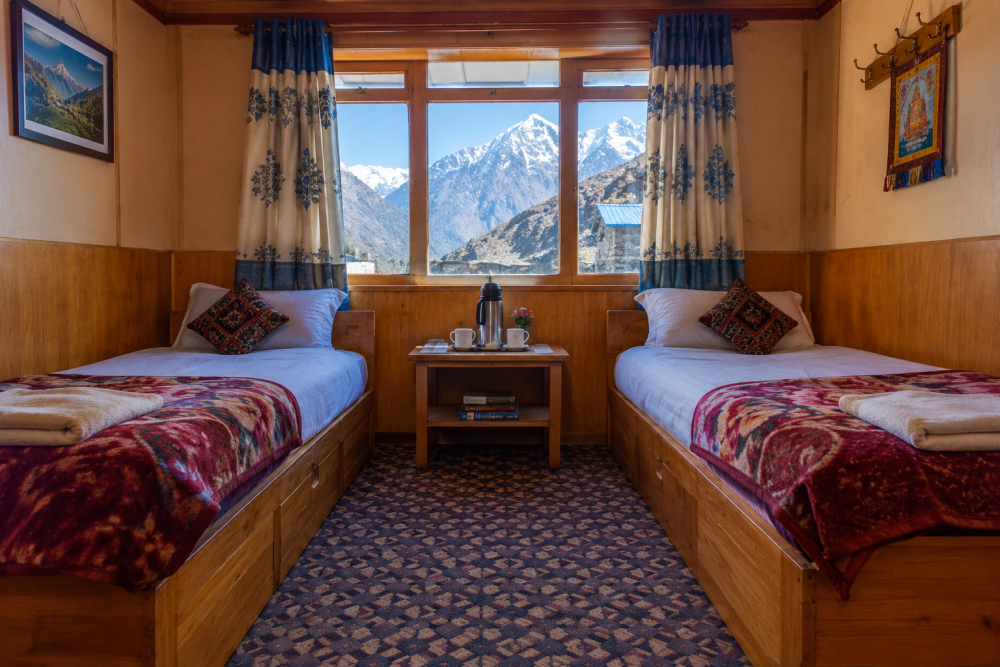
Think small and practical. Two narrow beds face each other with barely enough floor for your bags. Walls are thin wooden panels, so sound travels. A small light, often solar, hangs overhead. Some rooms have a little shelf or table.
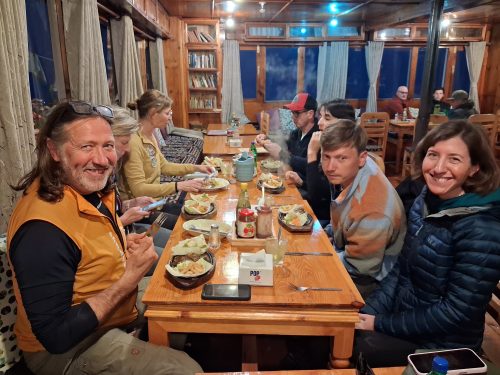
The heart of every teahouse is the dining room. A central stove, often burning dried yak dung, keeps it warm through the evening. This is where you eat, charge devices, play cards and meet trekkers from around the world.
| Stop | Altitude | What to expect |
|---|---|---|
| Lukla | 2,860 m | Comfortable lodges, some with attached bathrooms. Prices rise in peak season. |
| Phakding | 2,610 m | Quiet riverside stay. Simple rooms, mostly shared bathrooms. |
| Namche Bazaar | 3,440 m | The widest choice: guesthouses, hotels and a few luxury options. |
| Tengboche | 3,867 m | Limited lodges beside the monastery. Cosy, cold and scenic. |
| Dingboche | 4,410 m | Many lodges, from basic to comfortable. Cold nights. |
| Lobuche | 4,940 m | Few lodges, basic rooms, limited hot water. |
| Gorak Shep | 5,164 m | Highest and simplest. Small rooms, few facilities. |
Up to about Dingboche, you can often find private bathrooms, hot showers, and Wi-Fi. Beyond that, comfort drops quickly because every item is carried up by porters or yaks.

At Tengboche, try to catch the monastery’s morning or evening prayers. They are one of the trek’s most memorable moments.
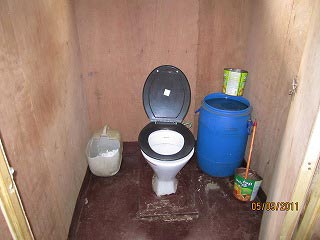
Toilets. Lower villages may have Western-style toilets. Above roughly 4,000 m, squat toilets are more common, and many are outside the main building. Toilet paper is not provided, so carry extra, especially in winter.
Showers. Cold water is usually free. A hot shower typically costs around $3 to $6. Hot water gets scarcer, and pricier, with altitude.
Charging. Expect to pay roughly $2 to $4 per hour per device, often at a single charging point. A power bank saves money and trouble.
Internet. Most lodges sell Wi-Fi by data card, and speeds drop as you climb. If you want a mobile connection, a local SIM card can be bought in Kathmandu with your passport copy and a passport photo. Check current operators and coverage before you buy.
These are rough guides. Prices shift with season, altitude and lodge, so confirm current rates before publishing or travelling.
| Type | Approx. price per night |
|---|---|
| Basic teahouse room | $5 to $8 |
| Standard lodge | $15 to $20 |
| Luxury lodge | $50 to $150 |
Many teahouses keep room prices low because they earn from meals, so they expect you to eat where you sleep. Also budget for showers, charging, toilet paper and monastery entry fees.
Teahouse dining rooms offer a surprisingly varied menu, especially in the lower villages. You can usually find dal bhat, rice, vegetable curry, noodles, fried rice, momos, pasta, soups, pancakes, eggs, potatoes, and bread, along with plenty of hot tea and coffee. As you gain altitude, the menu becomes simpler because supplies are harder to transport.
Dal bhat remains one of the most popular choices for trekkers. A typical plate includes rice, lentil soup, vegetables, and curry, and additional servings are often available. It provides a filling combination of carbohydrates and protein for long trekking days.
At higher elevations, warm, freshly prepared vegetarian meals are generally a practical choice. It is also useful to order dinner a little earlier, particularly at busy teahouses, as the dining room can become crowded around the usual evening meal time.
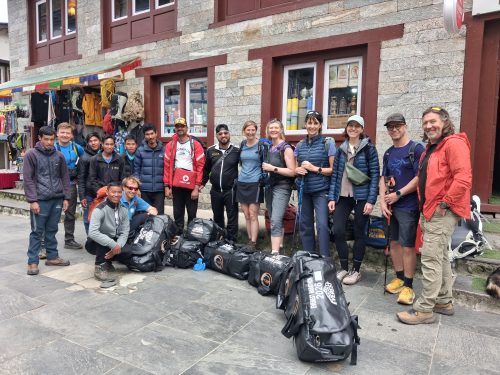
Spring (March to May) and autumn (late September to November) are the busiest months. Rooms fill quickly, and Lobuche and Gorak Shep, with their few lodges, are the tightest. Booking ahead through an agency that arranges your lodges is the safest way to secure a bed, and it helps if you want a more comfortable room. Your guide, who knows local conditions, can often help find alternatives on a crowded day.
In winter and the monsoon, crowds thin out, but nights are colder or wetter, and some high lodges close.

Accommodation on the Everest Base Camp trek is mainly provided in local teahouses and lodges, with simple but comfortable rooms. Most rooms have two beds, so solo trekkers are commonly paired with another trekker of the same gender, particularly during busy trekking seasons.
Solo travelers who prefer more privacy can sometimes request a single room for an additional charge, although private rooms are limited and may not be available at higher elevations or during peak season.
For groups, teahouses generally arrange several rooms together, making check-in and room allocation easier. Sharing accommodation also creates opportunities to meet other trekkers, exchange experiences, and enjoy the friendly atmosphere of the Himalayan dining rooms. As you reach higher elevations, accommodation becomes more basic, so flexibility is important for both solo travelers and groups.
If you value extra comfort, better sleep, or more privacy, upgrading your accommodation for a few nights can be worthwhile. Namche Bazaar and other lower-elevation villages generally offer more accommodation choices, including rooms with better facilities.
As you climb higher toward Everest Base Camp, accommodation becomes simpler and private rooms may be limited or unavailable. Rather than expecting luxury at high altitude, prioritize a good sleeping bag, warm clothing, and proper rest. For most trekkers, a few comfortable nights at lower elevations can be a practical way to balance comfort and budget.
Most trekkers stay in teahouses and mountain lodges along the route. They provide a basic private or shared room and a common dining area.
Most rooms are designed for two people, although single rooms may be available in lower villages. Private rooms become less common as you gain altitude.
Most rooms do not have private attached bathrooms, especially at higher elevations. Shared bathrooms are common, while some lower-elevation lodges offer rooms with attached facilities.
Yes, private rooms are sometimes available, particularly in Namche Bazaar and lower villages. They may cost extra and cannot always be guaranteed during busy seasons.
If you are traveling alone, you may be assigned a twin room with another trekker, normally of the same gender. A private room can be requested where available.
Many teahouses offer hot showers for an additional fee, but availability becomes more limited at higher elevations. Hot water may be heated using gas, solar power, or other local systems.
Most teahouses have some form of electricity, but availability can vary. Charging electronic devices usually costs extra, particularly at higher elevations.
Wi-Fi is available at many teahouses, but the connection can be slow or unreliable, especially higher on the trail. Some lodges charge separately for internet access.
Many teahouses provide blankets, but they may not always be sufficient for very cold nights. Trekkers should bring a good-quality sleeping bag suitable for high-altitude conditions.
Bedrooms are generally not individually heated. The dining room is usually the warmest communal area, often with a stove or heating system used during the evening.
Rooms generally have simple beds with mattresses, pillows, and blankets. Facilities become more basic as you approach higher elevations.
Accommodation can often be arranged ahead of time, especially when trekking with a guide or organized group. During busy periods, however, room availability can become limited, so flexibility is important.
It depends on the trekking package. Many organized EBC packages include teahouse accommodation along the trekking route, while independent trekkers normally pay directly at each lodge.
During peak trekking seasons, popular villages can become busy. Your guide or trekking company can help find available accommodation, and you may need to stay at another nearby lodge or accept a shared room.
Accommodation becomes very basic at higher elevations. Rooms are usually simple and facilities are limited, so trekkers should focus on warmth, rest, and proper acclimatization rather than expecting hotel-style comfort.
So, what are Everest Base Camp trek accommodations really like? Simple, cold in the bedroom, warm in the dining room, and full of heart. You won’t find luxury at 5,000 metres, but you will find kindness, hot tea and a bed that feels like a reward after a long day.
Pack a proper sleeping bag, book early in peak season and choose your upgrades wisely.
Ready to plan your trek? Contact Safe Holiday Adventure Pvt. Ltd. for your Everest Base Camp trek with carefully chosen lodges and experienced local guides.
There is a moment on every Everest trek when your legs have an opinion. For most people, it arrives
Continue Reading
If you are asking how difficult the Everest Three Passes Trek is, the honest answer is this: it is t
Continue Reading
My name is Peng Chang, and I travelled to Nepal from Malaysia with a small group of friends. Before
Continue Reading
In this story Why I Chose Everest Base Camp My name is Chyling, and I come from Malaysia, a country
Continue Reading
Ask anyone who has finished the Annapurna Circuit which day they remember most, and the answer is al
Continue Reading
Introduction Kathmandu doesn’t ease you in. You step out of the airport into a chorus of horns
Continue Reading