

23 Oct 2026 13 min to read
There is a moment at Annapurna Base Camp when the sun touches the rim of the sanctuary and every peak around you turns gold, one after another. Most trekkers earn that moment with six or seven days of steady climbing. The smartest ones also plan how they will leave it. An Annapurna Base Camp helicopter return luxury journey keeps everything that makes the trek special, the villages, the forests, the slow walk into the mountains, and replaces the long, knee-testing descent with a short flight back to Pokhara.
This guide walks you through what that journey really feels like, day by day, what “comfort-first” honestly means at 4,130 metres, and how to decide whether this style of trek is right for you.

Trekkers who have done the classic route often say the same thing: the way up is the adventure, and the way down is the repeat. After two or three days of walking uphill, you reach the base camp tired and happy. Then you still face roughly three more days of descent through the same valley, often on stone steps that punish tired legs.
The helicopter return changes the rhythm of the trip. You still walk into the Annapurna Sanctuary on your own feet and feel the landscape change from farmland to forest to high alpine meadows. But once you have stood at the base camp, a helicopter lifts you out of the valley in about twenty to twenty-five minutes, and you are back in Pokhara in time for a late breakfast and a hot shower.
This style suits several kinds of travellers. Some have only a week in Nepal. Some are walking with parents or partners who prefer an easier ending. Others simply want to save their energy and joints for the days that matter most.

Every journey begins in Kathmandu, where our team meets you at the airport and takes you to your hotel. After a night in the city to rest and sort your gear, you travel to Pokhara. You can fly in around twenty-five minutes, with a window seat on the north side offering your first glimpse of the Himalayan wall, or you can take a private vehicle for the longer road journey of roughly six to seven hours along the river valleys.
Pokhara is a gentle place to begin. The lake is calm, cafés line the shore, and on a clear evening Machhapuchhre, the Fishtail Mountain, glows above the water. Many guests spend a relaxed night here before the trek begins. It is also a good place to check your equipment, confirm permits, and meet your guide face to face.

The trek starts with a drive from Pokhara toward Nayapul, or further toward Kimche for the Ghandruk route, which takes about an hour and a half to two hours. From here the trail climbs through terraced fields of millet and rice, past small tea stops and stone-paved lanes.
Ghandruk is one of the most beautiful Gurung villages in the region. Slate-roofed houses cling to the hillside, and on a clear morning Annapurna South and Machhapuchhre stand directly above the rooftops. It is a wonderful place to arrive in the afternoon, sit with a cup of tea, and let the journey slow down.
The next day takes you onward to Chhomrong, the last big village before the sanctuary. The trail dips into river gorges and climbs again, which gives your legs their first real workout. Chhomrong sits on a ridge with a wide view of the mountains ahead, and it feels like the doorway to the high Himalaya.

Beyond Chhomrong, the character of the trek changes. You descend to the Chhomrong Khola and then climb through thick forest of bamboo, rhododendron and oak. This is the section where the air turns cooler and the sound of the Modi Khola river follows you for hours.
In spring, the rhododendrons bloom red and pink across the hillsides. In autumn the skies are crisp, and the forest is calm and green. You pass through Sinuwa, Bamboo, Dovan and Himalaya, small clusters of lodges where trekkers share tables and trade stories at dinner. As you gain height, the trees thin out and the valley opens, and you reach Deurali, the gateway to the alpine zone.
This is also where a comfort-first approach starts to matter. Our guides plan shorter days here so your body can adapt gradually, and we choose the best-located, cleanest lodges available on each stop.
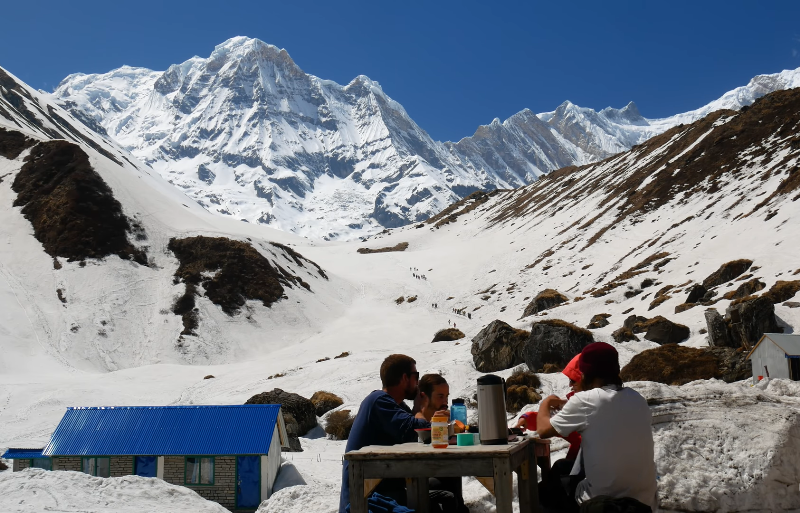
Above Deurali, the path crosses open slopes with views of the great amphitheatre of peaks. You climb steadily to Machhapuchhre Base Camp at around 3,700 metres, a quiet cluster of lodges below the iconic Fishtail. Trekkers cannot climb Machhapuchhre itself, since the mountain is considered sacred, but the base camp offers a front-row view of its sharp summit.
Many itineraries spend the night here or at Deurali, then complete the final walk to Annapurna Base Camp the next morning. The last stretch is short in distance, but the thinner air makes it feel longer. As the trail rises, the glacier-carved basin spreads out around you, and Annapurna I, Annapurna South, Hiunchuli, Gangapurna and Machhapuchhre form a nearly complete circle of ice and rock.

Annapurna Base Camp sits at 4,130 metres. It is a modest place, a handful of lodges, prayer flags and a stone marker, but the setting is among the finest in the world. Annapurna I, the tenth highest mountain on earth, rises directly in front of you.
Most guests spend the evening watching the light change and wake before dawn to see sunrise on the peaks. Bring warm layers, a hot drink and patience. The cold is sharp at this height, but the first sun on the summit ridge makes every step feel worthwhile.
This is also the point where the helicopter return makes its biggest difference. Instead of turning around and facing the long walk down, you stay on the mountain a little longer, enjoy your breakfast in the sanctuary, and wait for your flight.
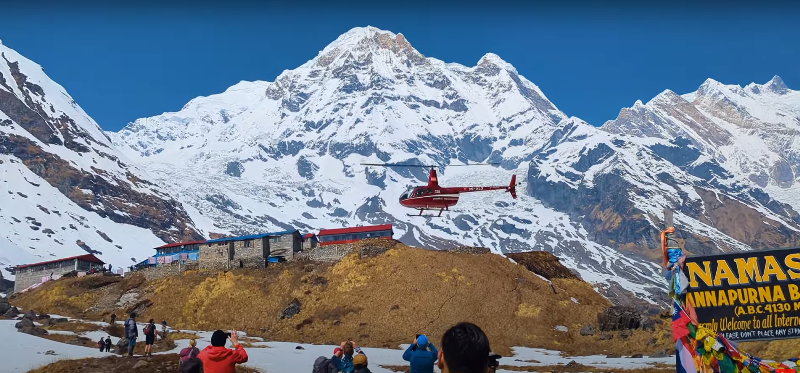
The return flight is arranged for the early morning, when the air is calm and the skies are usually clear. A helicopter flies in from Pokhara, lands on the designated pad near the base camp, and takes a small group of passengers on board. A standard helicopter carries up to five passengers, and the flight from the base camp to Pokhara takes roughly twenty to twenty-five minutes.
The view alone is worth the experience. You fly over the same river gorge you walked for days, pass the forests of Bamboo and Chhomrong, glide over Gurung villages and terraced hillsides, and arrive above Pokhara and Phewa Lake. A trail that takes three days on foot slips by in the time it takes to drink a cup of tea.
It helps to know a few honest points before you book. Helicopter flights in the mountains depend entirely on weather and visibility. Flights may be delayed by clouds or wind, so your plan should include a spare day or a backup option on foot. Your guide will monitor the forecast and stay in contact with the operator, so you are never left guessing.
The word luxury can mislead people on a Himalayan trek, so it is worth being honest. There are no five-star hotels inside the Annapurna Sanctuary. What you can have is the best-managed version of the journey, with careful choices at every step.
In Kathmandu and Pokhara, that means well-located, high-quality hotels with proper beds, good food and quiet rooms. On the trail, it means the cleanest and best-positioned lodges, private rooms where possible, attached bathrooms at lower altitudes, and warm dining rooms with hot meals cooked fresh. It also means a porter carrying your main bag so that you walk with only a light daypack, and a guide who sets a gentle pace and pays close attention to how everyone feels.
The comfort also comes from planning. Your permits are arranged, your transfers are timed, your flight is confirmed, and your days are not rushed. You spend your energy on the mountains, not on logistics.

A helicopter return makes the trip easier on the way down, but the walk up is still a real Himalayan trek. You will spend six to seven days on the trail, walking roughly five to seven hours a day, with plenty of stone steps and a few steep climbs, especially between Chhomrong and Bamboo and near Deurali.
The highest point, 4,130 metres, is high enough to cause altitude symptoms in some people. Headaches, poor sleep and loss of appetite are common warning signs. The best protection is a steady pace, plenty of water, enough rest and honest communication with your guide. Do not treat the helicopter as a guaranteed emergency exit, because bad weather can ground it. Good travel insurance that covers high-altitude trekking and helicopter evacuation is essential.
A few weeks of regular walking, stair climbing and light cardio before you arrive will make the experience far more enjoyable.
Autumn, from late September to November, is the most popular season. Skies are clear, the air is dry and the mountain views are excellent. Spring, from March to May, is the second favourite, with warmer days and blooming rhododendron forests, though afternoon clouds are more common.
Winter can be beautiful, quiet and cold, with heavy snow possible near the top. The monsoon, from June to August, brings rain, leeches and cloudy skies, and it is the hardest season for helicopter operations. For a comfort-first trek with a helicopter return, autumn and spring give the best chance of smooth flights and clear views.
Prices vary widely, so it helps to know what drives them. The cost of a trek like this depends on your hotels, the length of the itinerary, whether you travel privately or in a small group, and how many people share the helicopter. A helicopter flight is a shared cost, so a full group of up to five passengers is usually far more economical per person than a flight with one or two travellers.
When you compare quotes, look at what is included: hotel nights in Kathmandu and Pokhara, guide and porter services, permits, lodge stays, meals, ground transfers and the helicopter itself. A low price that leaves out the helicopter or the permits is not really a low price. We are happy to prepare a transparent quote based on your dates, group size and comfort level.
This journey is a great fit if you want the full Annapurna experience in about a week without a long walk back. It suits couples, small families with teenagers, first-time Himalayan trekkers who want extra support, and travellers with limited time. It is also a thoughtful choice for anyone who loves walking but wants to protect their knees on the descent.
It is less suitable if you want a fully off-the-grid wilderness experience or if you are on a very tight budget. In that case, a classic teahouse trek may be a better match.
Safe Holiday Adventure Pvt. Ltd. is a local Nepali trekking agency, and our team knows these trails, lodges, and weather patterns well. We plan every trip around your pace, your comfort and your time, and we are honest about what to expect in the mountains.
If you would like to reach Annapurna Base Camp in style and fly home over the valley you just walked, send us your dates and group size. We will design a plan that fits you and give you a clear, simple quote.
Your sanctuary sunrise is waiting.
1. What is a luxury Annapurna Base Camp trek?
It is the classic ABC route with upgraded comfort: better hotels in Kathmandu and Pokhara, the best available lodges on the trail, a guide, a porter, and often a helicopter return.
2. Is there real luxury on the ABC trail?
Not five-star. Inside the sanctuary, lodges are simple, so “luxury” means the best-located, cleanest lodges, better service and smoother planning.
3. How many days does it take?
Most itineraries run 8 to 12 days, including 6 to 7 days of trekking.
4. How high is Annapurna Base Camp?
4,130 metres (13,550 feet).
5. How difficult is a luxury ABC trek?
Moderate. The comfort is better, but you still walk 5 to 7 hours a day with steep stone steps and altitude.
6. Do I need trekking experience?
No, but good fitness helps. Start walking, stair climbing and cardio a few weeks before.
7. What is the best time to go?
Autumn (late September to November) and spring (March to May) offer the best views and weather.
8. How much does it cost?
Prices vary by hotel level, group size, days and helicopter use. Always compare what is included, and ask for a clear written quote.
9. What does the price usually include?
Hotels, guide, porter, permits, lodge stays, meals, transfers and, if booked, the helicopter flight.
10. How long is the helicopter flight from ABC to Pokhara?
Around 20 to 25 minutes, depending on weather.
11. How many people can share the helicopter?
Usually up to 5 passengers.
12. Can the helicopter always fly?
No. Clouds and wind can cause delays, so keep one spare day in your plan.
13. Is the helicopter return safe?
Flights are operated by licensed Nepali companies and only in suitable weather. Your guide monitors conditions.
14. Will I get altitude sickness?
It is possible above 3,000 metres. Walk slowly, drink water, rest well and tell your guide about any symptoms.
15. Do I need a guide and porter?
A guide is strongly recommended, and a porter lets you walk with a light daypack.
16. Which permits do I need?
The Annapurna Conservation Area Permit and the required local entry fees or TIMS. Your agency arranges them.
17. Do I need travel insurance?
Yes. Choose a policy covering trekking up to 4,130 metres and helicopter evacuation.
18. What is the food like?
Fresh, hot and simple. Expect dal bhat, noodles, soups, eggs, pasta and local tea.
19. Is there Wi-Fi and electricity?
Charging and basic Wi-Fi are available in many lodges for a small fee, but signal gets weaker with height.
20. Why book with Safe Holiday Adventure?
We are a local Nepali agency with experienced guides, careful planning and honest advice from arrival to departure.

There is a moment on the Annapurna Circuit that every trekker thinks about for days. It happens in t
Continue Reading
Most people walk to Everest Base Camp and then walk back down the same valley. The Three Passes Trek
Continue Reading
There is a moment on every Everest trek when your legs have an opinion. For most people, it arrives
Continue Reading
If you are asking how difficult the Everest Three Passes Trek is, the honest answer is this: it is t
Continue Reading
My name is Peng Chang, and I travelled to Nepal from Malaysia with a small group of friends. Before
Continue Reading
In this story Why I Chose Everest Base Camp My name is Chyling, and I come from Malaysia, a country
Continue Reading