
23 Oct 2026 10 min to read
There is a moment on the Annapurna Circuit that every trekker thinks about for days. It happens in the dark, somewhere around four in the morning, when you step out of a cold teahouse with a headlamp strapped over your hat and look up at a black slope that disappears into the stars. Somewhere above you is Thorong La, the pass at 5,416 metres, and the only way to reach it is on foot.
If you are planning this crossing, the two questions you will ask first are simple. How long does it take to walk from Thorong Phedi to the top of the pass, and how far is it? The honest answer is that the numbers look small on paper and feel enormous on the trail. This guide gives you the real figures, then tells you what hides behind them.
From Thorong Phedi (about 4,450 m), the walk to the top of Thorong La is roughly 5 to 6 kilometres, and most trekkers take between 4 and 6 hours to reach it. The vertical gain is close to 970 metres.
If you sleep at Thorong High Camp (about 4,880 m) instead, the remaining distance is much shorter, around 3 kilometers, and the climb usually takes 2.5 to 3.5 hours.
Those are averages. A strong, well-acclimatized walker on a clear morning might touch the prayer flags in under four hours from Phedi. Someone feeling the altitude, or fighting fresh snow, may need six or more. Both are normal, and neither is a failure.
Look at the map and the stretch above Thorong Phedi seems almost too short to matter. A few kilometres, a morning’s walk, nothing dramatic. Then you start climbing, and the numbers stop meaning what they usually mean.
The first reason is the air itself. Above 4,500 metres, every lungful holds far less oxygen than you are used to, and your body answers by working harder for every single step. Trekkers often settle into a slow, almost meditative pattern: a handful of steps, a long pause, a few deep breaths, then onward. Guides call this the pass rhythm, and they teach it on purpose. Walking this way is not a sign that you are struggling. It is how people actually reach the top.
The second reason is the cold, which arrives long before the sun does. In the dark hours of an autumn or spring start, temperatures on the upper slope often fall well below freezing, and a steady wind can make it feel far harsher. Zips jam, water turns to slush, and gloved fingers refuse simple jobs like opening a snack bar. Each small delay adds minutes, and those minutes pile up.
So when someone tells you the walk takes four to six hours, believe them, and plan around the slow pace rather than fighting it. On Thorong La, patience gets you to the prayer flags faster than speed does.
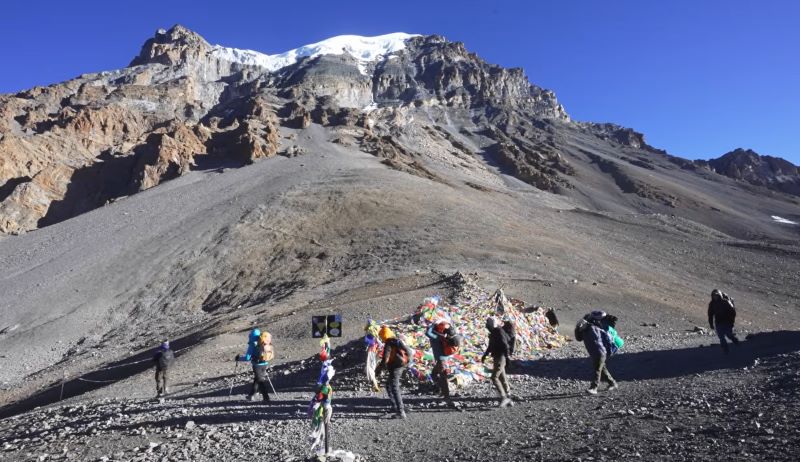
It helps to stop thinking of the route as one long slope and see it as three distinct chapters.
Phedi means “foot of the hill” in Nepali, and the name is accurate. Directly above the lodges, the trail kicks up in tight, steep switchbacks across a rocky face. The walk to High Camp is only about a kilometre or a little more, yet it gains roughly 430 metres in about an hour to an hour and a half.
Plenty of trekkers walk up here in the afternoon as an acclimatisation exercise, then return to Phedi to sleep lower. It is a smart trick. The body gets a taste of the altitude, and the next morning’s climb feels less like a shock.
Past High Camp, the gradient softens, and this is where many people relax a little too early. The path winds across wide, windswept terrain, climbing in long, patient lines. Distances feel deceptive because there are no trees, no villages and few landmarks, only ridgelines that appear closer than they are.
This stretch takes the longest per kilometre. The air is thinnest, the cold is sharpest, and the false summits begin. You will crest a rise, see prayer flags in the distance, and feel your spirits lift, only to find another rise behind it. Keep your pace steady and your expectations flexible.
The last section to the pass is gentler in slope but heavy in effort. A small teahouse stands near the summit and often has tea ready, one of the great small pleasures of the trek. Then comes the line of prayer flags, the wooden sign marking 5,416 metres, and a wide, quiet saddle with mountains stretching in every direction.
Everyone moves differently, so here is how the climb tends to look in practice.
A fit trekker who is well acclimatised and starting from Phedi typically reaches the top in about 4 to 5 hours. Someone with average fitness and a steady pace will often need 5 to 6 hours. A slower walker, or anyone dealing with headache, nausea or heavy snow, may take 6 to 7 hours or more.
Starting from High Camp cuts roughly an hour and a half to two hours from each of these. This is the main reason many guides prefer to sleep at High Camp when conditions and acclimatisation allow, though the trade-off is a higher sleeping altitude, which we will return to below.
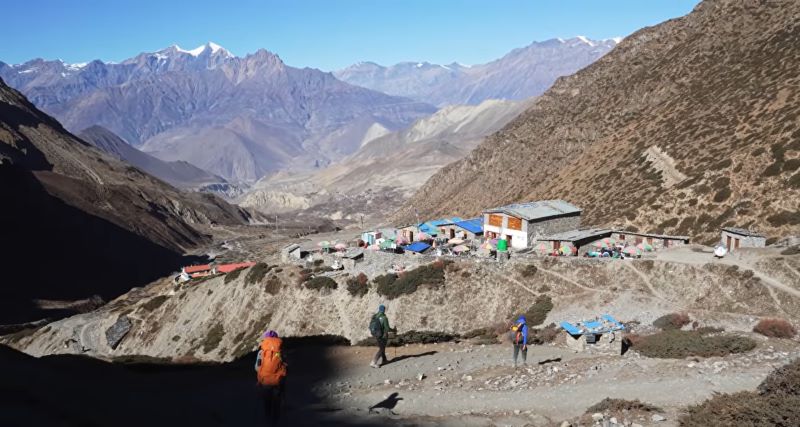
Reaching the pass is only half the day, and this is where people underestimate the crossing. From Thorong La, the trail drops steeply to Muktinath at about 3,760 metres. That is a descent of roughly 1,650 metres over about 8 to 9 kilometres, and it takes most trekkers 4 to 5 hours.
Put together, the full day from Thorong Phedi to Muktinath is often 9 to 11 hours of walking, including breaks. Knees and thighs take a beating on the descent, especially on loose gravel sections. Trekking poles are not optional here; they are a genuine gift to your joints.
Plan for a long day, pack snacks you can reach without stopping, and do not book anything ambitious for the afternoon. A hot meal and a bed at Muktinath will feel like luxury.
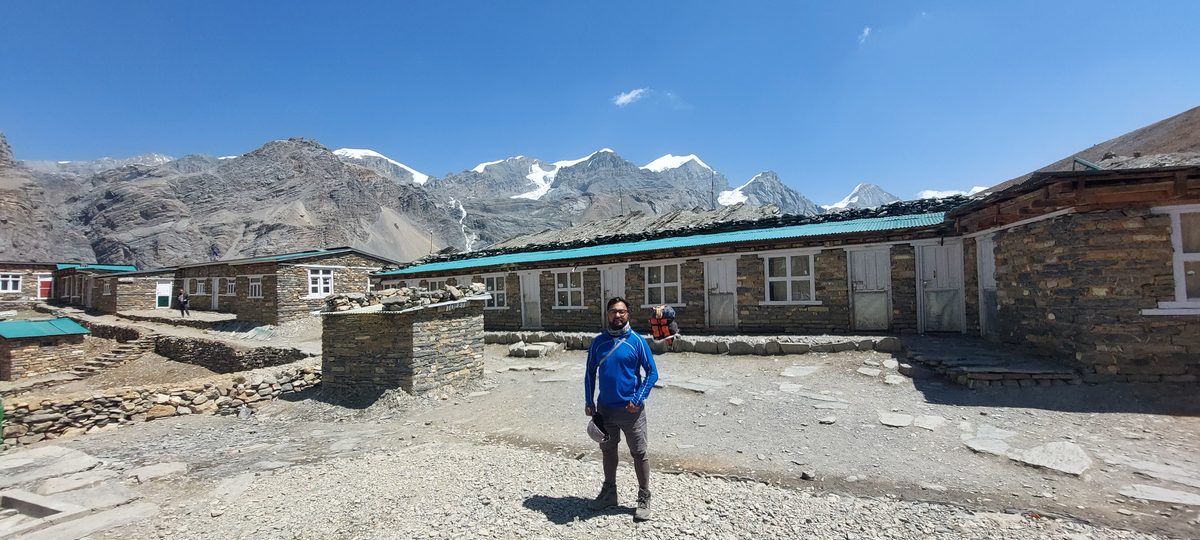
This is the great debate among trekkers, and both sides have a point.
Sleeping at Thorong Phedi keeps you at a lower altitude overnight, around 4,450 metres. Sleep tends to be better, and acute altitude symptoms are less likely. The cost is a longer, harder climb the next morning.
Sleeping at High Camp puts you at roughly 4,880 metres. You save the first steep hour and a half of the climb, and the summit day feels shorter. But sleeping that high can bring headaches, restless nights and a higher risk of altitude illness, particularly if you have rushed your acclimatisation.
A reasonable rule of thumb: if you have been feeling strong, have spent a night or two at Yak Kharka or Ledar, and your guide agrees, High Camp is a fair choice. If you have had any symptoms at all, or you are travelling in colder months, Phedi is the more cautious option.
Almost every experienced guide gives the same advice: leave early, usually between 3:30 and 5:00 a.m. This is not about being dramatic. It is about wind.
By late morning, the wind across Thorong La often picks up strongly, and it can be punishing. Starting before dawn means you reach the top while the air is calmer, then descend before the afternoon gusts arrive. You also get to watch the sky change colour over the Himalaya while you climb, which makes the early alarm worth every second of lost sleep.
Check the sunrise timing for your travel month and plan your departure around it. In the shorter days of late autumn, you may be climbing a good portion in darkness, so a reliable headlamp with fresh batteries is essential.
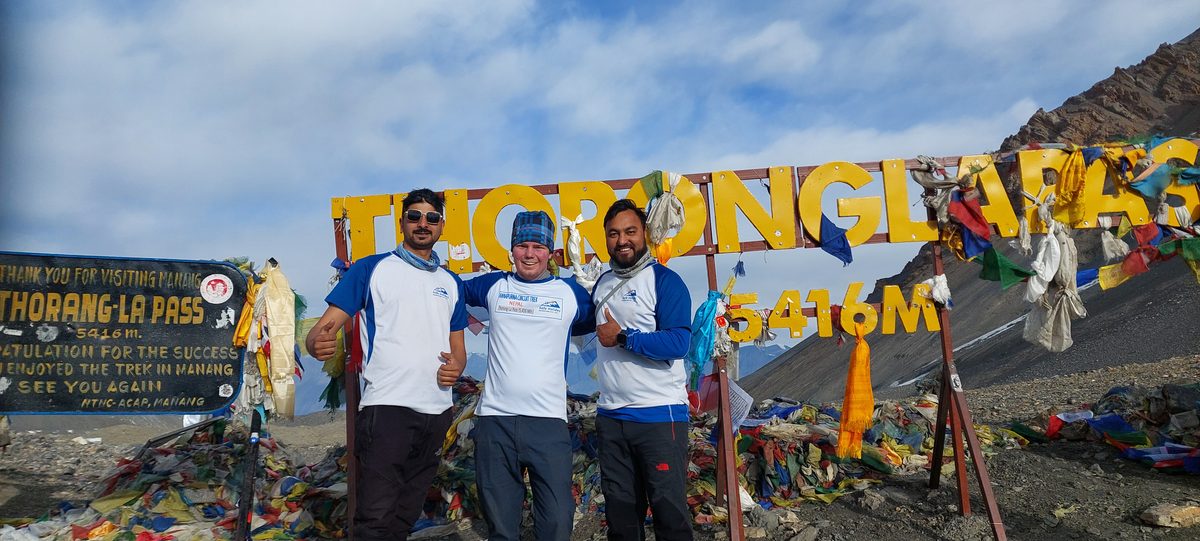
Thorong La is not technically difficult. There are no ropes, no crampons in normal conditions, and no scrambling. What makes it serious is height, and that deserves respect.
Know the warning signs of altitude sickness: persistent headache, nausea, dizziness, unusual fatigue, loss of appetite and poor sleep. Mild symptoms can be managed by slowing down, drinking water and resting. But if symptoms worsen, especially confusion, loss of balance or breathlessness at rest, the only safe response is to descend immediately. No view is worth a life.
Some practical habits that help:
You do not need exotic equipment, but you do need warm, reliable basics. Layering is the secret: a thermal base layer, a fleece or light down mid layer, and a windproof, insulated outer jacket. Add a warm hat, a buff to protect your face, and insulated gloves, ideally with a thin liner underneath.
Boots should be broken in, waterproof and warm enough for sub-zero starts. Sunglasses or glacier glasses matter more than people expect, since snow glare at altitude can be harsh even on cloudy days. Trekking poles help on both the ascent and the brutal descent.
Carry your water in insulated bottles or keep them upside down in your pack so the cap does not freeze first. A small thermos of warm tea feels like a miracle at the top.
The best windows for crossing are generally Spring (March to May) and Autumn (late September to November), when skies are usually clearer and conditions more predictable. Winter crossings are possible but can be bitterly cold, with heavy snow occasionally closing the pass. The monsoon months bring less rain on the Manang side of the circuit, but cloud and unstable weather can still affect visibility.
Whatever the season, treat the forecast as flexible. Pass conditions can change quickly, and a good guide will adjust the plan without hesitation. If the pass is unsafe on your chosen day, waiting a day is far better than pushing through.
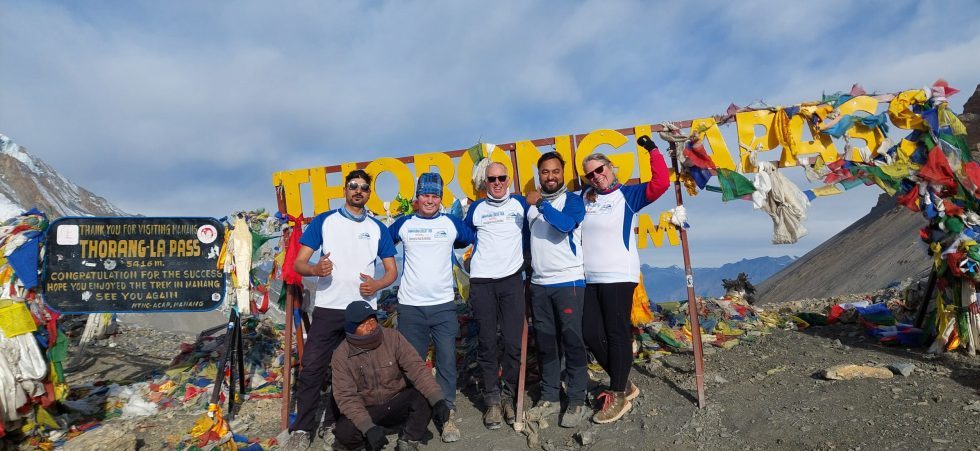
Then there is the reward. After hours of slow, breathless walking, the path finally flattens. Prayer flags snap in the wind. Trekkers hug each other, some cry quietly, others just laugh at nothing in particular. The Annapurna range stretches in one direction and the dry, golden Mustang valley opens up in the other. You have crossed one of the world’s great high-altitude trails on your own two legs.
Take your photo, drink your tea, and do not linger too long. The cold finds you quickly once you stop moving, and the long descent is still waiting.
The walk from Thorong Phedi to Thorong La is short in distance but huge in meaning. Expect around 5 to 6 kilometres and 4 to 6 hours from Phedi, or about 3 kilometres and under 3.5 hours from High Camp. Respect the altitude, start early, dress warmly and let your body set the pace.
With good acclimatisation, a steady rhythm and an experienced guide beside you, the pass is far more achievable than its reputation suggests. If you are ready to turn this dream into a real plan, the team at Safe Holiday Adventure Pvt. Ltd can help you organise a safe, well-paced Annapurna Circuit crossing with experienced local guides.
Note: Distances and timings are approximate and vary with conditions, season and individual fitness. Please double-check current trail and weather conditions before your crossing.
Most people walk to Everest Base Camp and then walk back down the same valley. The Three Passes Trek
Continue Reading
There is a moment on every Everest trek when your legs have an opinion. For most people, it arrives
Continue Reading
If you are asking how difficult the Everest Three Passes Trek is, the honest answer is this: it is t
Continue Reading
My name is Peng Chang, and I travelled to Nepal from Malaysia with a small group of friends. Before
Continue Reading
In this story Why I Chose Everest Base Camp My name is Chyling, and I come from Malaysia, a country
Continue Reading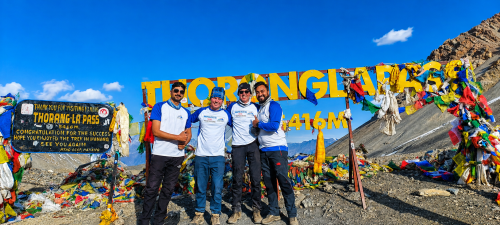
Ask anyone who has finished the Annapurna Circuit which day they remember most, and the answer is al
Continue Reading