

4 Sep 2017 15 min to read
The Jiri to Everest Base Camp (EBC) Trek is a classic and historic route that takes you through the foothills of the Himalayas to the iconic EBC. The trek starts from the small town of Jiri and follows the same path used by Sir Edmund Hillary and Tenzing Norgay Sherpa during their historic first ascent of Mount Everest in 1953.
The Jiri to EBC Trek is a longer and more gradual ascent compared to the popular Lukla to EBC Trek and takes around 19 to 21 days to complete. The route takes you through lush forests, traditional Sherpa villages, and high-altitude terrain with panoramic views of snow-capped mountains, including Mount Everest, Lhotse, Nuptse, Ama Dablam, and more.
The trail passes through various points of interest, such as the famous Namche Bazaar, the gateway to the Khumbu region, and the Tengboche Monastery, which is one of the oldest and most famous monasteries in the region. The trek also includes a visit to Kala Patthar, a popular viewpoint that offers a breathtaking panoramic view of Mount Everest and its surrounding peaks.
Overall, the Jiri to EBC Trek is a challenging and rewarding experience for trekkers looking to explore the natural beauty and cultural heritage of the Himalayas while also challenging themselves physically and mentally.
Yes, the EBC (Everest Base Camp) trek is definitely known for its spectacular views of the Himalayan Mountains, including Mount Everest. Some of the other highlights of the EBC trek include:

Enjoy Spectacular Himalayan Mountain Views During Everest Base Camp Trekking
Yes, the Everest Base Camp Trek offers spectacular views of the Himalayan mountains, including Mount Everest. As you walk through the Khumbu region of Nepal, you will encounter dramatic valleys, snow-covered peaks, glaciers, suspension bridges, and traditional Sherpa villages.
Throughout the trek, the mountain scenery changes with the altitude. You can admire impressive peaks such as Everest, Lhotse, Nuptse, Ama Dablam, Thamserku, and Pumori from different sections of the trail. The views from Namche Bazaar, Tengboche, Dingboche, Gorak Shep, and Kala Patthar are particularly memorable.
Reaching Everest Base Camp is an unforgettable achievement, while the sunrise panorama from Kala Patthar provides one of the finest viewpoints of Mount Everest and the surrounding Himalayan peaks. The combination of towering mountains, glaciers, valleys, and Sherpa culture makes the Everest Base Camp Trek a remarkable Himalayan adventure.

While most trekkers now fly directly into Lukla, the original route to Everest Base Camp starts on foot from the hill town of Jiri — the same path Sir Edmund Hillary and Tenzing Norgay’s expedition used in 1953. It’s longer, quieter, and gives you a much deeper look at the Himalayan foothills before the “official” EBC trail even begins.
The Jiri to EBC trek typically takes 18–20 days round trip, roughly a week longer than the standard Lukla fly-in route. That extra time is spent walking through mid-hill terrain — rolling ridgelines, river valleys, and traditional villages — before joining the main Everest trail at Lukla or Phakding.
From Jiri, the trail climbs and drops repeatedly across a series of ridges, passing through forests of rhododendron (Nepal’s national flower) that bloom red, pink, and white in the spring months. Lower down, the hillsides are shaped into terraced fields, hand-built with stone retaining walls, where local farmers grow potatoes, barley, and buckwheat — a working landscape rather than a scenic backdrop.
The early stages of the trek pass through mixed hill communities — Chhetri, Tamang, and Rai villages — before the trail enters Sherpa territory closer to the Khumbu region. This gradual cultural shift is one thing the fly-in route skips entirely: by the time you reach Namche Bazaar, Tengboche, and Dingboche, you’ve already seen how the landscape and communities change with altitude.
This is a genuinely demanding trek, more so than the standard EBC route. The constant ridge-and-valley terrain in the first week involves significant daily elevation gain and loss, even before the high-altitude sections begin. A reasonable level of fitness and multi-day hiking experience is recommended.
Reaching Everest Base Camp via Jiri isn’t the fastest way to get there — but it’s arguably the most complete way to experience the Khumbu region, from its lower hill villages all the way up to the foot of the world’s highest mountain.
The Sherpa are an ethnic group of Tibetan origin who settled in the Khumbu region several hundred years ago, and they remain closely tied to Tibetan Buddhism, mountaineering, and high-altitude trade. On the Jiri to EBC route, you’ll pass through their villages gradually rather than all at once, giving a clearer sense of how Sherpa life is shaped by altitude, weather, and the mountaineering economy.
Monasteries along the way
Tengboche Monastery, the largest in the Khumbu region, sits at 3,860m with a direct view of Ama Dablam and is worth timing your visit around if the monks are holding their morning prayer session. Smaller gompas (Buddhist monasteries) in Khumjung and Pangboche are quieter but equally active places of worship, not just photo stops.
Village life and hospitality
Teahouses along the route are typically family-run, and many trekkers end up staying with the same host families on the way up and back down. It’s common to be offered butter tea or a bowl of tsampa (roasted barley), and simple things — asking a few words of Nepali or Sherpa, respecting monastery etiquette (walking clockwise around chortens and mani walls) — go a long way with hosts who deal with a lot of transient foot traffic.
Cultural landmarks worth noting
This gradual cultural immersion is one of the clearest advantages of the Jiri route over flying directly into Lukla — by the time you reach Everest Base Camp, the trek has been as much about the people and villages as about the mountain itself.
The Jiri to Everest Base Camp trek is rated moderate to difficult, largely because of the terrain in its first week. Unlike the fly-in route from Lukla, this trail crosses a long series of ridges and valleys before it even reaches the main Everest trail — meaning you climb and descend repeatedly, day after day, well before the high-altitude sections begin.
By the numbers
What makes it harder than the standard route
The early stage from Jiri isn’t high-altitude, but it’s physically demanding — constant elevation change with limited flat walking. This is a different kind of difficulty from the altitude challenges later on, so trekkers need reasonable stamina for sustained daily hiking, not just acclimatization fitness.
What you get in return
The extra effort trades convenience for a fuller experience: rhododendron forests, working terraced farmland, a handful of Buddhist monasteries, and a slower introduction to Sherpa villages before reaching the busier Khumbu trail. It’s a trade most trekkers who choose this route make deliberately, rather than a compromise.
For anyone with solid fitness and some multi-day hiking experience, the Jiri route rewards the added distance with a more complete picture of the region — not just the mountain at the end of it.
The Jiri to Everest Base Camp route passes two Buddhist monasteries that see far fewer visitors than the main Khumbu trail — one modest and remote, the other one of the most important religious sites in the region.
Taksindu Monastery
Perched above the village of Taksindu at around 2,880m, this modest monastery is one of the older religious sites in the Solu region, sitting along a quiet stretch of trail well before the trek reaches the Khumbu proper. It’s a low-key stop — a place to rest, look around, and get a first sense of the region’s Buddhist heritage — rather than a major attraction in itself. The detour typically comes in the first week of the trek, depending on your daily pace.
Tengboche Monastery
Tengboche, the largest monastery in the Khumbu region, sits at 3,867m on a ridge with an open view of Everest, Ama Dablam, Lhotse, and Nuptse. It was founded in 1916 by Lama Gulu and has survived a difficult history — destroyed by an earthquake in 1934 and again by fire in 1989, then rebuilt both times with local and international support. Around 60 monks live there today, and visitors can usually observe the morning prayer session. If your timing lines up, autumn brings Mani Rimdu, one of the most significant Sherpa festivals, featuring masked ritual dances performed at the monastery.
Planning the detour
Tengboche sits directly on the main EBC trail (between Namche Bazaar and Dingboche), so no real detour is needed — most itineraries simply schedule a night there. Taksindu requires a short side stop earlier in the trek and is easy to combine with an overnight in the village.
Gokyo Ri isn’t on the standard Jiri to EBC trail, but it’s worth knowing about if you’re considering extending your trek: this 5,357m peak sits above the Gokyo Valley, reached via a separate branch of trail from Namche Bazaar rather than from Base Camp itself.
What you get for the climb
From the summit, you can see four of the world’s 8,000m peaks in one view — Everest, Lhotse, Makalu, and Cho Oyu — along with the Ngozumpa Glacier, the largest glacier in the Himalayas, and the turquoise Gokyo Lakes below. Many trekkers rate the sunrise view from here as more striking than the more crowded viewpoint at Kala Patthar near Base Camp.
How to fit it into a Jiri to EBC itinerary
Reaching Gokyo Ri means diverting off the main EBC trail at Namche Bazaar and following the Gokyo Valley route instead — roughly 3–4 days each way through Dole and Machhermo before reaching Gokyo village and climbing the peak. Combining this with Everest Base Camp usually means also crossing Cho La Pass (5,420m) to rejoin the main trail near Lobuche, turning the trip into the more demanding “EBC via Gokyo and Cho La” route rather than a simple add-on.
Worth knowing before you commit
If your goal is simply reaching Everest Base Camp, this is an optional detour rather than part of the core route — but for trekkers with the extra time and stamina, it’s widely considered one of the best viewpoints in the entire region.
Sagarmatha National Park — Nepal’s most famous protected area and a UNESCO World Heritage Site since 1979 — surrounds the entire upper section of the Everest region. Established in 1976, the park spans 1,148 square kilometers of the Solukhumbu District, ranging from around 2,845m at its lowest entry point up to Everest’s summit at 8,849m. Trekking from Jiri to Everest Base Camp takes you through nearly the full elevation range of the park, from forested lower valleys to the barren high alpine zone near Base Camp itself.
Flora
The park’s vegetation shifts dramatically with altitude. Lower elevations are covered in forests of pine, fir, hemlock, and juniper, along with rhododendron — Nepal’s national flower — which blooms in shades of red, pink, and white each spring. Above the treeline, vegetation thins into alpine scrub and grassland, and above roughly 5,000m almost nothing grows at all. One of the park’s more distinctive high-altitude flowers is the Himalayan blue poppy, which appears in the alpine zone during the brief summer flowering season.
Fauna
The park is best known for the snow leopard, though this elusive cat is rarely seen by trekkers. More commonly spotted wildlife includes the Himalayan tahr (a wild goat found on rocky slopes), musk deer, and — increasingly documented by camera trap studies — the red panda, one of the park’s flagship species. Bird life is abundant too, with over 100 recorded species including the Himalayan monal (Nepal’s colorful national bird), blood pheasant, and snow cock.
What this means for the trek
Because the Jiri route passes through nearly every ecological zone in the park, it offers a more gradual introduction to this changing landscape than the fly-in route via Lukla, which starts much higher and skips the lower forest zones entirely. Wildlife sightings are never guaranteed, but the changing terrain — forest, rhododendron groves, high pasture, and finally barren alpine rock — is itself one of the more memorable parts of the trek.
At 5,545m, Kala Patthar is a rocky viewpoint on the southern ridge of Pumori, just above the village of Gorak Shep, and it’s the highest point most trekkers reach on the entire Everest Base Camp trail — including those coming via Jiri. It exists because of an odd quirk of geography: Everest Base Camp itself, despite sitting almost beneath the mountain, has no real view of Everest’s summit, which is hidden behind the Nuptse-Lhotse ridge. Kala Patthar solves that problem.
What you’ll actually see
Sunrise vs. sunset
Most trekkers climb Kala Patthar before dawn specifically for sunrise, when the first light hits Everest’s summit before reaching the valley floor. It’s colder and harder in the dark, but the payoff — watching the world’s highest peak turn gold while everything around it is still in shadow — is the reason most itineraries build in an early start here rather than an afternoon visit.
Getting there
The climb starts from Gorak Shep (5,164m) and covers roughly 3–4km one way with about 300–400m of elevation gain. It’s short in distance but slow going — thin air and loose rock make it feel far harder than the numbers suggest, and 2–3 hours is a realistic estimate for most trekkers.
The Jiri to Everest Base Camp Trek is a classic Himalayan journey that takes you through beautiful mountain landscapes, remote Sherpa villages, and historic Buddhist monasteries. The longer approach from Jiri usually takes around 20–24 days, depending on your pace, acclimatization days, and chosen itinerary.
Taksindu Monastery, located at approximately 3,870 meters, is an important Buddhist monastery in the Solukhumbu region. Founded by Lama Dorje Rinchen, the monastery is known for its religious significance, traditional Buddhist practices, and collection of sacred artifacts and thangkas. Visitors can experience the peaceful atmosphere and, when appropriate, observe the monks during their daily prayers and rituals.
Further along the trail, Thyangboche (Tengboche) Monastery, at about 3,867 meters, is one of the best-known monasteries in the Khumbu region. Set against a spectacular Himalayan backdrop, it offers impressive views toward Mount Everest, Ama Dablam, Lhotse, and surrounding peaks. The monastery is also renowned for its traditional architecture, Buddhist paintings, religious ceremonies, and peaceful mountain setting.
Visiting these monasteries adds an important cultural dimension to the Jiri to Everest Base Camp Trek. Rather than simply walking through the mountains, you have the opportunity to learn about Sherpa culture, Tibetan Buddhism, local traditions, and mountain spirituality. For many trekkers, the quiet moments inside these monasteries become some of the most memorable experiences of the journey.

Namche Bazaar is where the Everest trail makes its biggest decision. Most trekkers turn right toward
Continue Reading
Nepal is famous for Mount Everest, the Annapurna Himalayas, ancient temples, traditional villages, a
Continue Reading
There is a moment at Annapurna Base Camp when the sun touches the rim of the sanctuary and every pea
Continue Reading
There is a moment on the Annapurna Circuit that every trekker thinks about for days. It happens in t
Continue Reading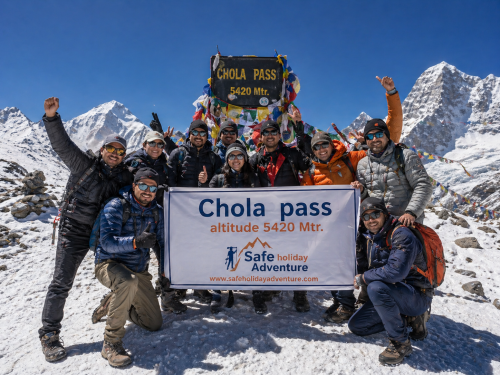
Most people walk to Everest Base Camp and then walk back down the same valley. The Three Passes Trek
Continue Reading
There is a moment on every Everest trek when your legs have an opinion. For most people, it arrives
Continue Reading