

Mera Peak Climbing from Khare Key Highlights: Highlights
- 3-Day Khare-to-Khare Climbing: A focused summit program starting and ending at Khare (5,045m), ideal for climbers who have already completed the approach trek.
- Mera Peak Summit at 6,476m: Reach the summit of Mera Peak, one of Nepal’s highest trekking peaks, after ascending through high-altitude snow and glacier terrain.
- Pre-Climbing Training: Receive practical training in crampon walking, ice-axe handling, rope techniques, harness use, and glacier safety before the summit attempt.
- Mera High Camp Overnight: Spend a night at Mera High Camp (around 5,780m) before beginning the early-morning summit push.
- Early-Morning Summit Climb: Start before dawn to reach the summit around sunrise, when weather and mountain visibility are often at their best.
- Glacier and Snow Climbing: Experience genuine high-altitude climbing using crampons, ice axe, harness, and climbing rope under the supervision of an experienced guide.
- Himalayan Summit Panorama: Enjoy spectacular views of Mount Everest, Lhotse, Makalu, Cho Oyu, and Kanchenjunga from the summit when weather conditions are clear.
- Expert Climbing Support: Climb with an experienced local team providing route guidance, technical support, safety monitoring, and summit assistance throughout the 3-day climbing section.
- Return to Khare: Descend safely after the summit and return to Khare, completing the dedicated 3-day Mera Peak climbing section.
Mera Peak Climbing from Khare: Introduction Overview
Mera Peak Climbing from Khare is the shortest and most practical way to reach the summit of Mera Peak (6,476m), Nepal’s highest trekking peak. This 3-day climbing package is designed for trekkers who have already reached Khare (5,045m) and want to join a professionally guided summit expedition. We provide experienced climbing guides, climbing permits, technical equipment, tents, and full climbing support directly from Khare, making your ascent safe, organized, and hassle-free.
The climb follows the classic route through Mera High Camp before ascending the glacier to the summit of Mera North (6,476m), the highest and officially recognized peak of Mera. From the top, climbers enjoy one of the finest Himalayan panoramas in Nepal, including Mount Everest, Lhotse, Makalu, Cho Oyu, and Kanchenjunga. Although Mera Peak is considered a non-technical trekking peak, good physical fitness and proper acclimatization are essential for a successful summit.
Our Mera Peak Climbing from Khare itinerary is ideal for independent trekkers, photographers, and adventure travelers who wish to complete the climb without organizing a full expedition from Kathmandu. Before departure, our certified climbing guide conducts a pre-climbing training session in Khare, covering the use of crampons, ice axe, harness, fixed rope, and glacier safety. This preparation makes the climb suitable for both beginners with trekking experience and experienced high-altitude hikers.
At Safe Holiday Adventure Pvt. Ltd., your safety is our highest priority. Our local Sherpa team carefully monitors weather conditions, manages logistics, and provides personalized support throughout the expedition. If you are looking for a reliable, affordable, and well-organized Mera Peak Climbing from Khare package, this 3-day adventure offers an unforgettable Himalayan summit experience with expert local guidance.
Is Mera Peak Climbing from Khare Worth It?
Mera Peak Climbing from Khare is worth it if you want a shorter, focused, and well-supported Himalayan summit experience. Starting from Khare (5,045m) means you can skip the longer trekking approach and concentrate on the most exciting part of the expedition—climbing toward Mera High Camp and the 6,476m summit.
This route is especially suitable for trekkers who have already acclimatized in the Everest region and want to experience glacier walking, crampon climbing, high-altitude adventure, and spectacular Himalayan views without committing to a long expedition. From the summit, you can enjoy impressive views of Everest, Lhotse, Makalu, Cho Oyu, and other Himalayan peaks.
With Safe Holiday Adventure Pvt. Ltd., you receive experienced climbing-guide support, essential climbing equipment, pre-climbing training, and carefully arranged logistics from Khare. If you are physically prepared and properly acclimatized, Mera Peak Climbing from Khare offers an excellent balance of time, adventure, and Himalayan summit experience.
Mera Peak Climbing Route from Lukla:
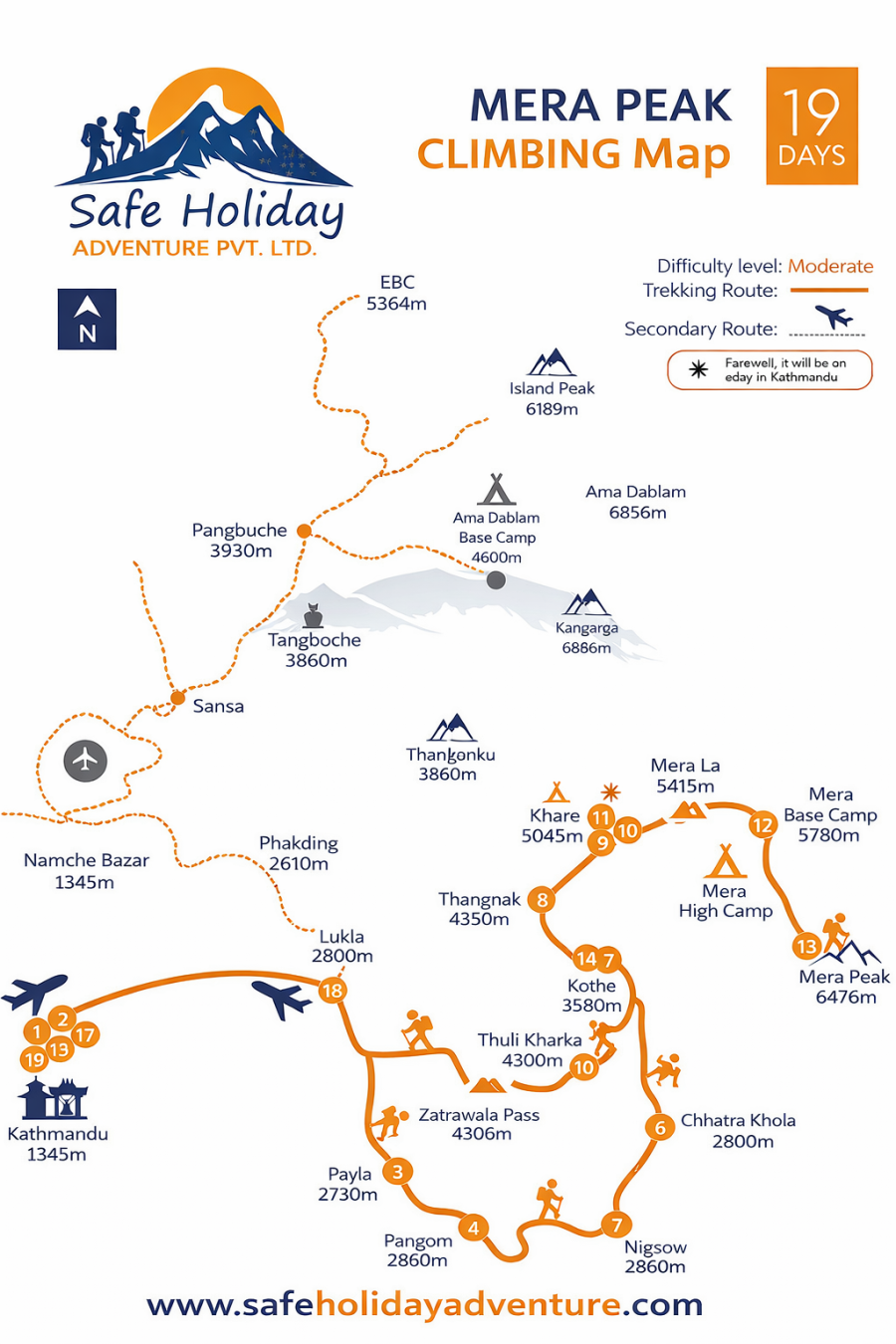
The Mera Peak Climbing route from Lukla begins with a scenic mountain flight from Kathmandu to Lukla (2,840m) and then enters the quieter trails of the Hinku Valley. From Lukla, the route continues through Paiya (Chutok) and Panggom, followed by Ningsow and Chhatra Khola. This section of the journey passes through beautiful forests, traditional mountain settlements, rhododendron-covered hills, and peaceful trails away from the busier Everest Base Camp route.
From Chhatra Khola, the trail continues toward Kothe, following the remote Hinku Valley and gradually gaining altitude. The route then leads to Thangnak (Tangnag), where the landscape becomes more alpine and the surrounding mountains and glaciers become increasingly prominent. From Thangnak, the trail climbs further to Khare (5,045m), the main preparation point for the Mera Peak ascent. The gradual progression from Lukla through Paiya → Panggom → Ningsow → Chhatra Khola → Kothe → Thangnak → Khare provides an important opportunity for acclimatization before the summit climb.
From Khare, the climbing route con
Why Climb Mera Peak with Safe Holiday Adventure?
- Experienced Local Climbing Team: Climb with an experienced local trekking and climbing team who understand Mera Peak, high-altitude conditions, mountain trails, and changing Himalayan weather.
- Carefully Planned Acclimatization: Our itinerary includes gradual altitude gain and proper acclimatization, helping your body adjust before reaching Khare, High Camp, and the summit.
- Pre-Climb Training at Khare: Before the summit attempt, our team provides practical training in crampon, ice axe, rope, and basic climbing techniques at Khare.
- Dedicated Climbing Sherpa Support: Our experienced climbing Sherpa provides essential support during high-altitude sections, including climbing preparation, route guidance, and summit assistance.
- Safety and Altitude Monitoring: We prioritize your safety with experienced guides, altitude awareness, and health monitoring, including oxygen saturation and pulse checks when needed.
- Permits and Major Logistics Managed: We arrange the essential climbing permits, transportation, accommodation, meals, guides, Sherpa support, and other major expedition logistics.
- Full-Board Meals and Accommodation: Enjoy breakfast, lunch, and dinner during the trek, along with accommodation in available lodges and mountain camps throughout the expedition.
- Flexible and Customized Itinerary: We can customize your Mera Peak itinerary according to your travel dates, experience, fitness level, and preferences while allowing adequate acclimatization time.
- 24/7 Local Support: Our Nepal-based team provides 24/7 local assistance before and during your expedition, from arrival in Kathmandu through the trek and return journey.
- Weather Contingency for the Summit: Our itinerary includes a summit contingency day, providing flexibility when weather or mountain conditions make the planned summit attempt unsuitable.
Mera Peak Climbing from Khare Itinerary:Outline Itinerary
Day 1: Meet Your Climbing Guide & Pre-Climbing Training in Khare (5,045m) | 2–3 hours of training | Gear check, climbing practice, acclimatization & summit briefing.
Day 2: Khare (5,045m) → Mera High Camp (5,780m) | Approx. 4–6 km | 5–7 hours | Cross rocky terrain and the Mera Glacier before reaching High Camp for an overnight tented stay.
Day 3: Mera High Camp (5,780m) → Mera Peak Summit (6,476m) → Khare (5,045m) | Approx. 12–15 km | 10–13 hours | 4–6 hours summit climb, early pre-dawn departure, glacier ascent, summit celebration, descent to High Camp, and return to Khare.
Services in The cost:
- Mera Peak Permit: Climbing permit, government fees, VAT, local taxes, and service charges.
- Professional Guide: Licensed, experienced, English-speaking, and first-aid-trained climbing guide.
- Staff Services: Guide and support staff wages, meals, accommodation, insurance, and allowances.
- Meals: Breakfast, lunch, dinner, and hot drinks as listed in the itinerary.
- Camping: One night of tented accommodation with essential camping and kitchen equipment.
- Climbing Gear: Group equipment including fixed ropes, main ropes, snow bars, ice tools, and other technical gear.
- Safety Support: First-aid kit, pulse oximeter, and supplemental oxygen carried by the climbing team.
- Emergency Assistance: Support with rescue coordination in case of a serious medical emergency.
- Pre-Climb Briefing: Trip briefing, itinerary review, and final preparation at our office before departure.
- Complimentary Gifts: Company T-shirt, sun hat, waterproof sticker, and a Mera Peak achievement certificate or medal.
- International Flights & Nepal Visa: International airfare and Nepal visa fees are not included.
- Travel & Medical Insurance: Personal insurance covering trekking, high-altitude climbing, medical care, and emergency rescue is mandatory.
- Domestic Flights: Airfare for domestic sectors required before or after the climbing itinerary is excluded.
- Personal Climbing Gear: Individual climbing equipment and clothing are your responsibility. Gear can be rented or purchased locally if required.
- Khare Accommodation & Meals: Extra accommodation and meals in Khare caused by early arrival, delayed departure, or an unplanned return are not included.
- Porter Service: Porter support for carrying personal baggage between Khare and Mera High Camp is available at an additional cost.
- Personal Climbing Guide: A private climbing guide can be arranged on request for an additional fee.
- Special Permits & Fees: Additional charges for filming, drones, photography, or other special permits are excluded.
- Tips & Gratuities: Tips for guides, porters, and support staff are not included and remain at your discretion.
- Other Personal Expenses: Any service, activity, or expense not specifically listed under Cost Includes is excluded.
Dates and Availability Departures
All our published dates are guaranteed departures. We also provide customized departures tailored to your travel plans.
There are no group joining dates available at the moment. Please contact us for a private trip.
Travellers Reviews
Genaral Trip InfoInfos
How Much Does 3-Day Mera Peak Climbing from Khare Cost?
The 3-Day Mera Peak Climbing from Khare package costs USD 725 per person on a regular group basis. This price is designed to provide a well-organized climbing experience with professional guide support and the essential services required for the summit journey.
For solo climbers, the cost is USD 820 per person because the expenses for guiding, logistics, and climbing support are shared by only one participant. If you are traveling with 5 or more people, Safe Holiday Adventure Pvt. Ltd. offers a special group discount, making the package more affordable for larger groups.
Our Mera Peak Climbing from Khare cost is based on the services and logistics provided for the 3-day climbing program. For an exact quotation based on your group size, travel date, and requirements, please contact Safe Holiday Adventure Pvt. Ltd.
Mera Peak Climbing Route from Lukla:
The Mera Peak Climbing route from Lukla begins with a scenic mountain flight from Kathmandu to Lukla (2,840m) and then enters the quieter trails of the Hinku Valley. From Lukla, the route continues through Paiya (Chutok) and Panggom, followed by Ningsow and Chhatra Khola. This section of the journey passes through beautiful forests, traditional mountain settlements, rhododendron-covered hills, and peaceful trails away from the busier Everest Base Camp route.
From Chhatra Khola, the trail continues toward Kothe, following the remote Hinku Valley and gradually gaining altitude. The route then leads to Thangnak (Tangnag), where the landscape becomes more alpine and the surrounding mountains and glaciers become increasingly prominent. From Thangnak, the trail climbs further to Khare (5,045m), the main preparation point for the Mera Peak ascent. The gradual progression from Lukla through Paiya → Panggom → Ningsow → Chhatra Khola → Kothe → Thangnak → Khare provides an important opportunity for acclimatization before the summit climb.
From Khare, the climbing route con
How Difficult Is Mera Peak Climbing?
Mera Peak climbing difficulty is moderate to challenging, mainly because of the high altitude, long trekking days, steep glacier sections, and cold conditions. At 6,461 meters (21,190 feet), climbers need good physical fitness, proper acclimatization, and basic mountaineering skills. The final summit involves snow and glacier climbing with crampons, ropes, and an ice axe. With adequate training, an experienced guide, and a well-planned itinerary, Mera Peak is achievable for fit beginners with little or no previous climbing experience.
What Is the Best Time to Climb Mera Peak?
The best time to climb Mera Peak is during spring (March to May) and autumn (October to November). These seasons generally offer stable weather, clearer skies, good visibility, and more favorable conditions for high-altitude climbing.
April, May, October, and November are especially popular months for summit attempts. Spring brings gradually warmer conditions, while autumn is known for crisp mountain views and generally dry weather.
Winter and monsoon are less suitable because of colder temperatures, snowfall, rain, clouds, and more unpredictable mountain conditions. For the best balance of weather, visibility, and climbing conditions, spring and autumn are the preferred seasons.
Is Mera Peak Suitable for Beginners?
Yes, Mera Peak can be suitable for fit beginners who have some hiking experience and a strong, positive mindset. It is an adventurous high-altitude climb, but you do not need extensive mountaineering experience when you have proper guidance and preparation.
With Safe Holiday Adventure’s experienced Sherpa climbing guides, you receive close support from Khare to the summit and back to Khare. The climbing section is also relatively short, taking only 2 nights and 3 days, making it a challenging but manageable adventure.
If you are physically fit, comfortable with long hikes, and mentally prepared for high altitude, our experienced climbing team can guide and support you toward the summit safely and confidently.
Mera Peak Climbing Gear List: What You Really Need
Mera Peak is a high-altitude climb reaching 6,461 meters, so having the right equipment is essential for warmth, safety, comfort, and successful summit preparation. You do not need to carry every piece of expensive mountaineering equipment, but you should have proper high-altitude clothing, trekking gear, climbing equipment, and personal essentials.
Clothing & Warm Layers
- Moisture-wicking base layers
- Fleece or warm mid-layer
- Down jacket
- Waterproof and windproof jacket
- Waterproof trekking trousers
- Insulated summit pants
- Thermal underwear
- Warm hat and sun hat
- Neck gaiter or buff
- Warm gloves and waterproof outer gloves
- Trekking socks and extra thick socks
Trekking & Personal Gear
- Comfortable trekking boots
- Backpack (40–50 liters)
- Daypack if required
- Sleeping bag rated for high altitude
- Trekking poles
- Headlamp with spare batteries
- Sunglasses and glacier glasses
- Water bottles or hydration system
- Water purification tablets or filter
- Sunscreen and lip balm
- Personal first-aid and medicines
Mera Peak Climbing Equipment
For the summit section, you will need proper mountaineering equipment such as:
- Mountaineering boots
- Crampons
- Mountaineering harness
- Climbing helmet
- Ice axe
- Ascender (Jumar)
- Carabiners
- Prusik sling
- Climbing rope and related technical equipment
Technical climbing equipment can normally be arranged through your climbing company, depending on the package and group requirements. Your guide will also check your equipment before leaving Khare for the high camp.
Important Summit-Day Items
The summit push can be extremely cold and windy, especially before sunrise. Make sure your summit kit includes warm insulated clothing, gloves, goggles, headlamp, sufficient water, high-energy snacks, and reliable climbing equipment.
What You Do Not Need to Overpack
Mera Peak is an adventurous high-altitude climb, but you do not need a huge amount of personal gear. Focus on lightweight, warm, reliable, and well-tested equipment. Your climbing guide can help you check the gear and identify anything missing before the summit attempt.
Mera Peak Climbing Training & Preparation:
Mera Peak requires good fitness, hiking experience, and strong mental preparation. You do not need to be a professional climber, but regular training before the trip will make the climb safer and more enjoyable.
- Build Strong Hiking Endurance – Train with long uphill walks, stairs, and weekend hikes to prepare your legs and lungs for high-altitude trekking.
- Improve Strength and Balance – Focus on your legs, core, and upper body to handle steep trails, a backpack, and climbing equipment.
- Practice Long-Day Hiking – Gradually increase your walking time and distance so your body becomes comfortable with several hours of activity.
- Prepare for High Altitude – Acclimatization during the Mera Peak itinerary is essential. Walk at a steady pace, stay hydrated, eat well, and follow your guide’s advice.
- Develop Mental Strength – Cold, steep terrain, early summit starts, and thin air can be challenging. A positive and determined mindset is just as important as physical fitness.
- Practice with Your Gear – Wear your trekking boots and test your backpack, layers, gloves, and other equipment before the climb. Properly fitted gear prevents unnecessary discomfort.
- Learn Basic Climbing Skills – Before the summit attempt, your experienced climbing guide provides practical instruction on using crampons, harnesses, ropes, and an ice axe.
You do not need to be an expert mountaineer. With proper preparation, basic hiking experience, good fitness, and professional Sherpa climbing-guide support, Mera Peak can be a challenging but achievable Himalayan adventure.
Mera Peak Climbing Permits and Entry Requirements:
Climbing Mera Peak (6,476m) requires several permits issued by the relevant Nepalese authorities. The main requirements include a Mera Peak climbing permit, Makalu-Barun National Park entry permit, and the applicable local area permit. Permit fees can vary depending on the climbing season and current government regulations.
With Safe Holiday Adventure, all required permits and official documentation are arranged in advance by our team. This ensures a smooth and hassle-free journey, allowing you to concentrate on acclimatization, climbing preparation, and reaching the summit safely.
What Is Mera Peak Summit Day Like?
Mera Peak summit day begins very early, usually around 1:00–2:00 AM, from High Camp. After a light breakfast and final gear check, you set off with your climbing guide under the night sky. The cold is intense, and the air becomes noticeably thinner with every step.
The route gradually leads across snow and glacial terrain toward the summit. The climbing itself is not highly technical in normal conditions, but the altitude makes the ascent physically demanding. Your pace needs to be slow and steady, with regular short breaks to manage your energy and breathing.
The final section is the most challenging part of the climb. Your experienced climbing guide stays with you, checks the route and conditions, and provides support where climbing equipment or fixed-rope techniques are required.
If weather and route conditions are favorable, you can reach the Mera Peak summit in the morning, often after several hours of climbing. Standing on the summit offers spectacular views across the Himalayan range, with Everest, Lhotse, Makalu, Baruntse, Chamlang, and other major peaks visible in the distance.
After enjoying the summit, the journey continues downhill to High Camp or a lower camp depending on the day’s itinerary and conditions. The descent is an important part of summit day, as fatigue can make the return more demanding than expected.
Overall, Mera Peak summit day is a long, cold, high-altitude adventure that requires good acclimatization, physical preparation, the right equipment, and professional climbing support. With proper preparation and a controlled pace, it can become one of the most memorable days of your Himalayan adventure.
When Is the Best Weather for Mera Peak Climbing?
The best weather for Mera Peak climbing is during spring (March to May) and autumn (September to November). These seasons usually bring clearer skies, more stable conditions, good visibility, and safer climbing conditions.
Autumn, especially October and November, is excellent for crisp mountain views and generally dry weather. Spring, particularly April and May, offers longer daylight, warmer temperatures, and beautiful Himalayan landscapes.
The monsoon months (June to August) are less suitable because of rain, clouds, and unstable trail conditions. Winter (December to February) can bring extreme cold, heavy snowfall, and strong winds at higher elevations.
For the best balance of weather, visibility, and climbing conditions, October, November, April, and May are among the most favorable months for Mera Peak.
Mera Peak vs Island Peak: Which Is Harder?
Mera Peak is higher, but Island Peak is more technical. Mera Peak reaches 6,476 meters, while Island Peak (Imja Tse) stands at 6,189 meters. The two climbs offer different challenges, so the harder peak depends on whether you find altitude and endurance or technical climbing more difficult.
Mera Peak vs Island Peak at a Glance
| Feature | Mera Peak | Island Peak |
|---|---|---|
| Altitude | 6,476 m | 6,189 m |
| Main challenge | Altitude & endurance | Technical climbing |
| Technical difficulty | Lower | Higher |
| Glacier travel | Yes | Yes |
| Fixed ropes | Limited/route dependent | Important on summit section |
| Steep ice | Less technical | Steeper headwall |
| Best for | Strong trekkers | Climbers seeking technical experience |
Which Peak Is Technically Harder?
Island Peak is technically harder. Its summit route includes glacier travel, steeper snow and ice, fixed-rope climbing, ascender (Jumar) use and an exposed summit ridge. These sections require greater confidence with climbing equipment and rope techniques.
Mera Peak is technically easier on the normal route, with the climb consisting mainly of snow and glacier travel. However, climbers still need crampons, an ice axe, proper glacier awareness and good mountain guidance. It should not be treated as an ordinary trek simply because the technical climbing is limited.
Which Peak Is More Physically Difficult?
Mera Peak can be more physically demanding because its summit is 287 meters higher and the climb places greater emphasis on endurance and altitude tolerance. The long summit push at more than 6,000 meters can be extremely tiring, even for fit trekkers.
Island Peak is also physically demanding, particularly when climbing steep terrain at high altitude. Its technical sections can make the summit day feel harder despite its lower elevation.
Which Is Better for a First-Time Climber?
For a fit trekker with little or no technical climbing experience, Mera Peak is generally the more straightforward choice. It offers a high-altitude mountaineering experience without the same level of steep fixed-rope climbing found on Island Peak.
Island Peak is a better option for climbers who want more technical experience, including fixed ropes, steeper ice and exposed climbing terrain.
Both peaks are serious 6,000-meter climbing objectives. Good fitness, acclimatization, appropriate equipment and experienced mountain support are essential.
Mera Peak or Island Peak: Which Should You Choose?
Choose Mera Peak if your priority is high altitude, endurance and a less technical summit climb.
Choose Island Peak if you want steeper climbing, fixed ropes and a more technical mountaineering experience.
In simple terms: Mera Peak tests your endurance and altitude tolerance, while Island Peak tests your climbing technique and confidence. Neither peak is easy, but Mera is generally the better starting point for strong trekkers, while Island Peak is more suitable for those looking for a technical climbing challenge.
Detailed ItineraryItinerary
Meet Your Climbing Guide and Pre-Climb Training in Khare.
Today is the final preparation day before you move into the higher and more demanding section of your Mera Peak climbing adventure. You will meet your climbing guide in Khare, where the team will check your personal equipment and make sure you have everything required for the ascent. If anything is missing or unsuitable, your guide can advise you about the necessary gear before the climb begins.
After the equipment check, you will have a practical 2–3 hour climbing training session. Your guide will demonstrate how to use crampons, an ice axe, climbing harness, ropes, and other essential equipment. You will also practice safe movement on snow and ice, basic rope techniques, and how to respond if conditions become difficult. The aim is not simply to teach technical skills but to make you comfortable with the equipment before summit day.
Khare itself is an important acclimatization point at 5,045 meters, and spending time here helps your body adjust before climbing higher. Depending on conditions and your group’s preparation, the guide may include a short acclimatization walk above Khare. In the evening, you will receive a detailed summit briefing covering the early start, weather conditions, pacing, clothing, hydration, safety procedures, and the planned turnaround time. You will then have an early dinner and rest before tomorrow’s climb toward Mera High Camp.
Day Highlights: Gear inspection • Crampon and ice-axe practice • Rope training • Acclimatization • Summit briefing • Khare mountain views
Accommodation : Lodge at Khare Meals : Breakfast, Lunch & Dinner
Khare (5,045m) to Mera High Camp
Day 2: Khare (5,045m) to Mera High Camp (5,780m)
Altitude gain: 735m | Overnight: Mera High Camp
After breakfast, you leave Khare and begin the most important high-altitude approach of the climb. The trail initially follows rocky and boulder-covered terrain as you gain elevation toward the upper Mera Glacier area. The landscape becomes increasingly alpine, with fewer signs of permanent settlement and a growing sense that you are entering a true mountaineering environment.
As you climb higher, the route reaches the Mera La area at around 5,400m before continuing toward the glacier and High Camp. Depending on snow and ice conditions, your guide will decide where crampons and other climbing equipment should be used. The terrain can be steep and exposed in places, so your pace will be deliberately steady. The goal is to reach High Camp safely while preserving enough energy for the summit attempt. Current route descriptions similarly place the High Camp around 5,780m and describe the approach as a combination of rocky terrain, snow, and glacier travel.
Mera High Camp sits at approximately 5,780 meters, on a rocky position above the glacier. As you arrive, the surrounding Himalayan panorama opens dramatically. On a clear day, you can see Everest, Lhotse, Makalu, Cho Oyu, Kangchenjunga, Chamlang, Baruntse, and numerous surrounding peaks.
Once camp is established, your guide will make the final preparations for the summit attempt. You will organize your climbing equipment, have something warm to eat, and receive a final weather and safety update. Because the summit day begins during the night, there is no long evening to enjoy at High Camp. The priority is to stay warm, hydrate, eat well, and get as much rest as possible before the early-morning departure.
Day Highlights: Rocky mountain trail • Mera La • Glacier terrain • High-altitude scenery • Everest and Makalu views • Mera High Camp at 5,780m • Final summit preparation
Accommodation : Mera High Camp Tented Camp Meals : Breakfast, Lunch & Dinner
Mera High Camp to Mera Peak Summit (6,476m) and Back to Khare
This is the summit day of your Mera Peak climb and the longest and most demanding day of the three-day climbing section. You will wake around 1:00–3:00 AM, depending on weather, snow conditions, and the guide’s final decision. After a light breakfast and a hot drink, you put on your climbing equipment, check your headlamp and crampons, and begin climbing into the darkness.
The first part of the ascent follows the snowy slopes of the Mera Glacier. Progress can feel slow at this altitude because the air is extremely thin, so your guide will set a controlled pace with regular short breaks. As dawn approaches, the surrounding mountains gradually appear in the early light. The climb continues across snow and ice toward the upper slopes, where conditions can determine whether fixed-rope protection is required on the steeper sections. Current route descriptions generally place the summit push at roughly 4–6 hours, although weather, snow conditions, fitness, and acclimatization can make the actual time longer or shorter.
Reaching Mera Peak at 6,476 meters (21,247 ft) is the defining moment of the climb. From the summit, you can enjoy an extraordinary panorama of some of the world’s highest mountains. On a clear morning, the view can include Mount Everest, Lhotse, Makalu, Cho Oyu, Kanchenjunga, Nuptse, Ama Dablam, Baruntse, Chamlang, and many other Himalayan peaks. Take time for photographs and to celebrate the achievement, but the summit stay must remain controlled because conditions at this altitude can change quickly.
After the summit celebration, you begin the descent along the same general route. Going down is not simply an easy walk; tired legs, changing snow conditions, and altitude still require careful movement. You return to High Camp, collect your remaining belongings, and continue descending toward Khare. Reaching Khare at 5,045m marks the end of the main climbing challenge, and the substantial loss of altitude will make recovery easier. Depending on the actual conditions and group pace, the complete summit-day schedule can take around 10–13 hours or longer.
Back in Khare, you can finally relax, enjoy a warm meal, and celebrate with your climbing team. The summit is behind you, but the journey is not necessarily finished—your following itinerary will take you back through the Hinku Valley toward the lower elevations.
Day Highlights: Pre-dawn glacier climb • Sunrise over the Himalayas • Mera Peak summit at 6,476m • Everest, Lhotse and Makalu views • Summit photographs • Descent to Khare • Celebration with the climbing team
Accommodation : Lodge at Khare Meals : Breakfast, Lunch & Dinner
3-Day Mera Peak Climbing from Khare FAQs
Refund & Cancellation Policy
- Booking requires 20% non-refundable deposit (Nepal) or 100% upfront (Tibet/Bhutan).
- Remaining payment due before the trip or on arrival (trip-dependent).
Cancellation charges:
- 31+ days: 20%
- 16–30 days: 45%
- 8–15 days: 75%
- 7 days or less: 90%
- Prices may change due to flights, taxes, or exchange rates.
- Trip changes are allowed, but extra costs apply.
- If the company cancels, a full refund, except for unavoidable events (some costs deducted).
- Good health and travel insurance are mandatory.
- No refund if removed for unsafe or illegal behavior.
- Travel involves personal risk, which the client accepts.